
When a loved one passes away in Australia, bringing them back to India involves several formalities. Along with arranging the funeral and transportation, the family needs to collect the right documents and complete the required procedures with the Australian authorities, funeral director and Indian Consulate.
For families already dealing with a difficult loss, handling paperwork can feel confusing. Knowing what documents are generally required can make the process easier and help avoid unnecessary delays.
This guide explains the important documents needed to bring mortal remains from Australia to India and what families should know before starting the repatriation process.
What Documents Are Required to Bring Mortal Remains From Australia to India?
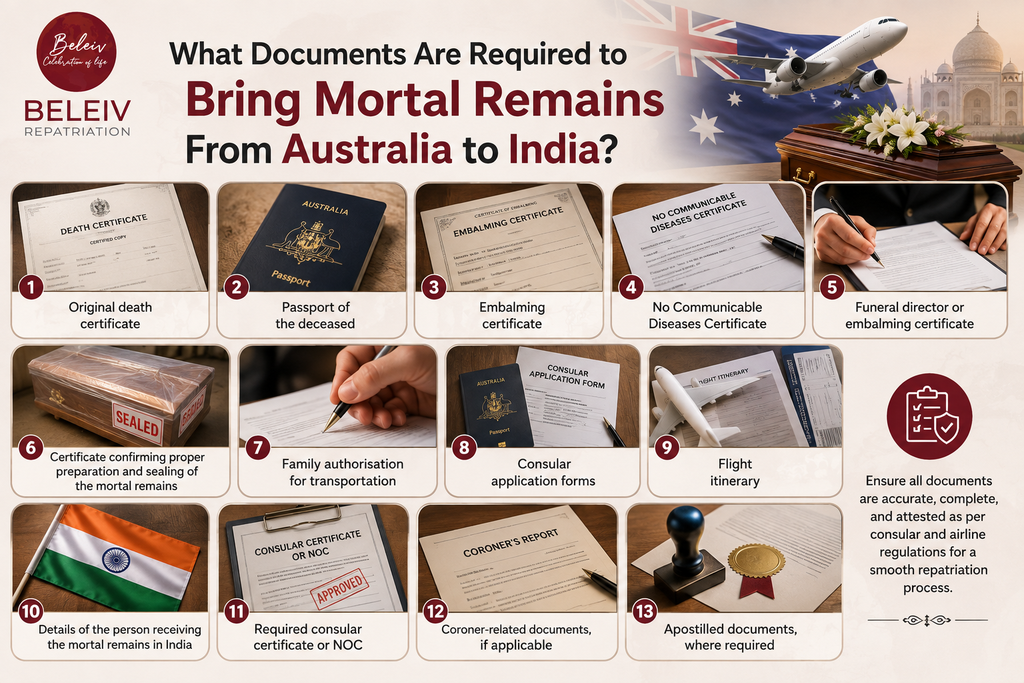
The exact requirements can vary depending on the Australian state or territory, circumstances of death and the Indian Consular jurisdiction.
Generally, families may need:
- Original death certificate
- Passport of the deceased
- Embalming certificate
- No Communicable Diseases Certificate
- Funeral director or embalming certificate
- Certificate confirming proper preparation and sealing of the mortal remains
- Family authorisation for transportation
- Consular application forms
- Flight itinerary
- Details of the person receiving the mortal remains in India
- Required consular certificate or NOC
- Coroner-related documents, if applicable
- Apostilled documents, where required
The requirements can be different if the family is transporting ashes instead of the body.
1. Original Death Certificate
The death certificate is one of the most important documents required for repatriation.
It confirms the basic details of the death, including:
- Name of the deceased
- Date of death
- Place of death
- Other official information recorded by the Australian authorities
The family should obtain the original certificate and keep it safely throughout the repatriation process.
In some cases, the death certificate may need to be authenticated or apostilled before it can be used for Indian consular formalities.
2. Passport of the Deceased
The deceased person’s passport is generally required as part of the consular process.
For an Indian citizen, the passport may need to be submitted to the Indian Consulate for cancellation and record purposes.
If the passport cannot be found, the family should inform the funeral director and the relevant Indian Consulate as soon as possible.
Do not assume that the absence of the passport can simply be ignored. The Consulate should confirm what alternative documentation is required.
3. Embalming Certificate
An embalming certificate confirms that the deceased has been prepared for international transportation.
The funeral director or embalmer generally arranges this document.
It may include information confirming that:
- The deceased has been embalmed.
- The mortal remains have been prepared for transportation.
- The body has been placed in the appropriate container.
- The container has been properly sealed.
This is an important document because the body must meet the requirements for international transportation and arrival in India.
4. No Communicable Diseases Certificate
A No Communicable Diseases Certificate may be required when transporting a body internationally.
The certificate confirms that the deceased did not have a communicable disease that would create a public health concern during transportation.
The funeral director or relevant medical authority can help the family obtain this certificate.
The requirement may differ when transporting ashes instead of a body.
5. Certificate for Proper Packaging and Sealing
The mortal remains need to be properly prepared and sealed before they can be transported internationally.
The funeral director or embalming service generally provides documentation confirming that the body has been placed in an appropriate sealed container.
This is important for both airline transportation and clearance after the mortal remains arrive in India.
The family should make sure the funeral director understands that the body is being transported internationally to India.
6. Family Authorisation
The family or next of kin may need to provide written authorisation for transporting the mortal remains to India.
This confirms that the family has approved the repatriation arrangements.
The authorisation may include details such as:
- Name of the deceased
- Name of the next of kin
- Relationship to the deceased
- Destination in India
- Name of the funeral director or repatriation service
- Signature of the authorised family member
The exact format can depend on the relevant consular requirements.
7. Consular Application Forms
The Indian Consulate may require specific application forms for death registration and transportation of mortal remains.
These forms need to be completed carefully.
Incorrect information, missing signatures or inconsistent details can result in additional questions or delays.
A funeral director or repatriation service can help the family prepare the forms correctly.
8. Flight Details
Once the arrangements are ready, the airline itinerary will be required.
The details may include:
- Departure airport in Australia
- Arrival airport in India
- Flight number
- Date of travel
- Connecting flight details, if applicable
- Cargo information
The flight should generally be arranged only after the required documentation and preparation are in place.
Booking a flight too early can create problems if the deceased has not yet been released or the required documents are still pending.
9. Details of the Person Receiving the Mortal Remains in India
Someone in India needs to receive the deceased after arrival.
This person may be a:
- Family member
- Relative
- Authorised representative
- Funeral service provider
The family may need to provide:
- Full name
- Address
- Phone number
- Relationship to the deceased
- Identification details, where required
These details should be accurate because they may be used during airport clearance and handover.
10. Coroner Documents, If Applicable
If the death was sudden, accidental or otherwise requires investigation, a coroner may become involved.
In such cases, additional documents may be required.
These can include:
- Coroner’s documents
- Post-mortem documentation
- Release documents
- Cause-of-death information
- Other documents issued by the relevant authority
The family should wait for the necessary authorities to release the deceased before finalising the repatriation arrangements.
11. Apostille or Authentication of Documents
Some Australian documents may need to be apostilled before they can be accepted for use in India.
This can apply to documents such as:
- Death certificate
- Embalming or funeral director certificate
- Cremation certificate, when transporting ashes
Whether a particular document requires an apostille depends on the current requirements of the relevant Indian Consular jurisdiction.
This is something the family should confirm before submitting the documents.
Documents Needed for Bringing Ashes From Australia to India
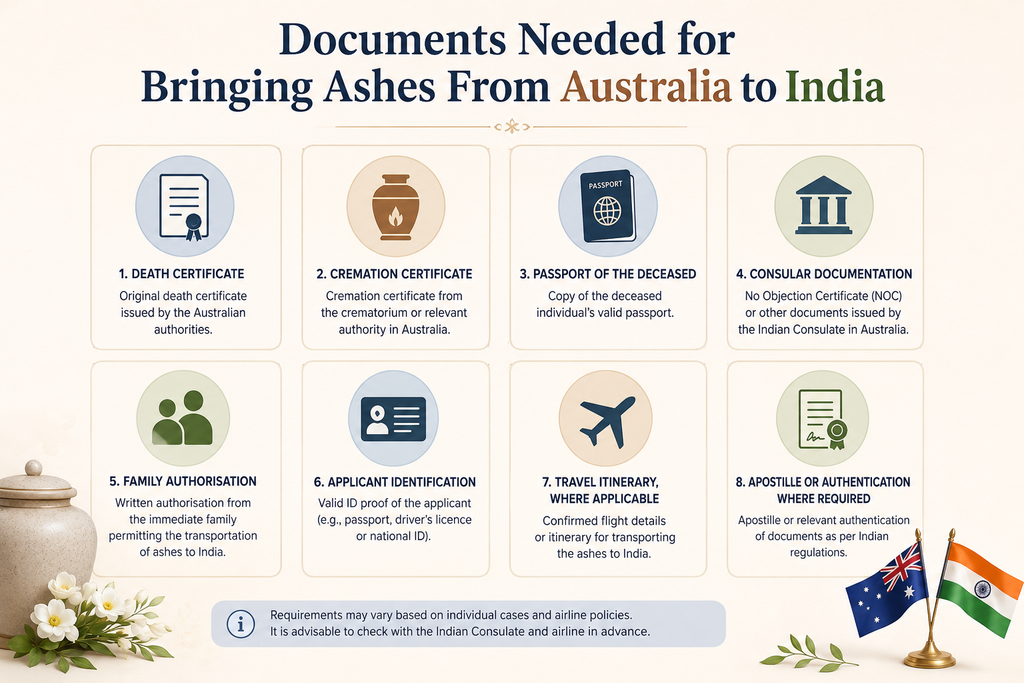
The documentation is slightly different when the family decides to cremate the deceased in Australia and bring the ashes to India.
Common documents can include:
- Death certificate
- Cremation certificate
- Passport of the deceased
- Consular documentation
- Family authorisation
- Applicant identification
- Travel itinerary, where applicable
- Apostille or authentication where required
Families should not assume that the documentation for ashes is exactly the same as the documentation for transporting a body.
Does Every Australian State Have the Same Requirements?
Not necessarily.
Australia has different states and territories, and local death registration and funeral procedures can vary.
The Indian Consular jurisdiction can also affect the procedure.
For this reason, families should not rely on an old checklist found online or assume that the requirements in Sydney are identical to those in Melbourne, Brisbane, Perth or another location.
The safest approach is to confirm the current requirements for the specific location where the death occurred.
What Happens If a Document Is Missing?
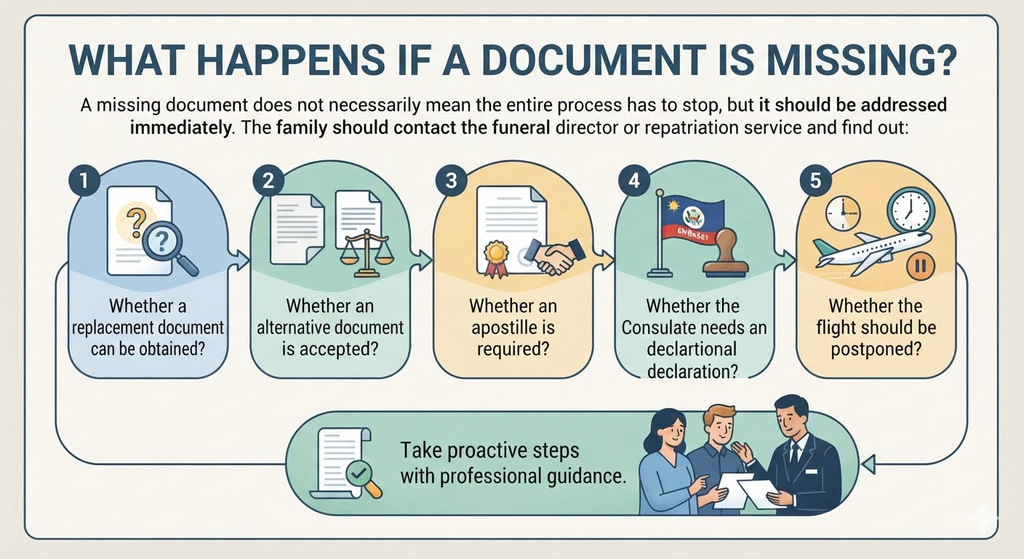
A missing document does not necessarily mean the entire process has to stop, but it should be addressed immediately.
The family should contact the funeral director or repatriation service and find out:
- Whether a replacement document can be obtained
- Whether an alternative document is accepted
- Whether an apostille is required
- Whether the Consulate needs an additional declaration
- Whether the flight should be postponed
It is much better to resolve documentation issues before the flight than to discover a problem at the airport.
What If the Death Was Accidental?
An accidental or unnatural death may require additional procedures.
The authorities may need to investigate the circumstances before the deceased can be released.
This can delay:
- Death certificate
- Release of the deceased
- Embalming
- Consular documentation
- Flight booking
- Final transportation
Families should therefore avoid assuming that an accidental death will follow the same timeline as a natural death.
When Should the Family Start Collecting the Documents?
It is best to start as early as possible.
Once the relevant authorities have confirmed the death and the funeral director has been appointed, the family can begin collecting the documents required for repatriation.
A simple way to stay organised is to keep all documents in one place and maintain a checklist.
For example:
- Death certificate — checked
- Passport — checked
- Embalming certificate — checked
- Health certificate — checked
- Family authorisation — checked
- Consular forms — checked
- Flight details — checked
- Consignee details — checked
- Apostille — checked, if required
This can make the process much easier to manage.
How Beleiv Repatriation Can Help
When a family is dealing with a death in another country, paperwork is often one of the most stressful parts of the process.
Beleiv Repatriation can help families coordinate the arrangements needed to bring mortal remains from Australia to India.
The support can include:
- Funeral director coordination
- Collection of the deceased
- Documentation guidance
- Embalming arrangements
- Consular coordination
- Assistance with required certificates
- Airline cargo arrangements
- Airport coordination
- Receiving arrangements in India
- Transportation to the final destination
Every case is different, so the exact documentation depends on the circumstances of the death and the location in Australia.
Common Documentation Mistakes to Avoid
Families can avoid many unnecessary delays by checking the paperwork carefully.
Try to avoid:
- Using an outdated document checklist
- Forgetting the deceased’s passport
- Submitting incomplete forms
- Providing incorrect consignee details
- Forgetting required authentication or apostille
- Booking the flight before the documents are ready
- Assuming body and ashes require the same documents
- Waiting until the last minute to contact the Consulate
If you are unsure about a particular document, ask before submitting the application.
Frequently Asked Questions
What is the most important document for bringing a body from Australia to India?
The original death certificate is one of the key documents. Other important documents can include the deceased’s passport, embalming certificate, No Communicable Diseases Certificate, family authorisation and required consular documentation.
Does the Australian death certificate need an apostille?
It may. The requirement depends on the relevant Indian Consular jurisdiction and the current rules. Families should confirm whether the death certificate needs an apostille before submitting it.
Is an embalming certificate required?
An embalming certificate is generally required when transporting mortal remains internationally. The funeral director or embalming service normally arranges it.
Is a No Communicable Diseases Certificate required?
It may be required for transporting a body. The exact requirement should be confirmed with the relevant Indian Consulate and authorities handling the case.
What documents are needed to bring ashes from Australia to India?
The family may need the death certificate, cremation certificate, passport of the deceased, family authorisation and applicable consular documentation. Additional authentication may also be required.
Does the deceased’s passport need to be submitted?
The deceased’s passport is generally required for the consular process and may be cancelled as part of the formalities.
Can a repatriation service help with the documents?
Yes. A professional repatriation service can help the family understand the required documents, coordinate with the funeral director and assist with consular and transportation arrangements.
Final Thoughts
Bringing mortal remains from Australia to India involves several documents, and getting the paperwork right can help prevent unnecessary delays.
The documents commonly involved include:
- Original death certificate
- Passport of the deceased
- Embalming certificate
- No Communicable Diseases Certificate
- Packaging and sealing certificate
- Family authorisation
- Consular application forms
- Flight itinerary
- Consignee details in India
- Coroner documents, where applicable
- Apostille or authentication, where required
The exact requirements can vary depending on the Australian state, circumstances of death and the relevant Indian Consular jurisdiction.
If the family is unsure where to begin, getting professional help early can make the process much easier.
Beleiv Repatriation can help families coordinate the documentation, funeral arrangements, consular formalities and transportation required to bring their loved one from Australia to India.