
When a loved one passes away in the UK, bringing them back to India can feel like another difficult task at an already painful time.
Families often have questions such as: What should we do first? Who should we contact? What documents are needed? How do we arrange the flight? What happens when the mortal remains reach India?
The process may look complicated, but it becomes easier when you break it down into individual steps.
This guide explains how to bring mortal remains from the UK to India, from the initial arrangements in the UK to transportation and the final handover in India.
Can Mortal Remains Be Brought From the UK to India?
Yes. The family can arrange for the mortal remains of an Indian national to be transported from the UK to India for the final funeral rites.
The process involves several parties, including:
- UK local authorities
- Funeral director or undertaker
- Indian High Commission or relevant Indian Mission
- Airline or cargo operator
- Airport health authorities in India
- Family or receiving representative in India
The High Commission of India in London issues a No Objection Certificate for transporting eligible mortal remains to India after the required formalities have been completed. It also requires the appointment of a funeral director or undertaker to complete the necessary transportation formalities.

Step 1: Report the Death and Complete UK Formalities
The first thing to do is make sure the death has been properly reported and handled under UK procedures.
What happens next depends on the circumstances of the death.
If the person died in a hospital or under medical care, the relevant medical and registration procedures will begin.
If the death was sudden, unexpected or requires investigation, a coroner may become involved.
Before the mortal remains can be prepared for international transportation, the necessary UK authorities generally need to complete their procedures and release the deceased.
Step 2: Choose a Funeral Director or Repatriation Service
Once the family decides to bring the deceased to India, appointing a funeral director or specialist repatriation service is an important step.
The funeral director can coordinate several parts of the process, including:
- Collection of the deceased
- Care and storage
- Embalming
- Preparation of the casket
- Required certificates
- Documentation
- Consular formalities
- Airline arrangements
- Transportation to the airport
The High Commission of India in London specifically requires the next of kin to appoint a Funeral Director or Undertaker for the transportation process.
For a family dealing with a loss, having one service coordinate these arrangements can make the process much easier.
Step 3: Register the Death With the Indian Mission
If the deceased was an Indian citizen, the death should be registered with the relevant Indian Mission.
The family generally needs documents such as:
- Death certificate
- Last-held Indian passport of the deceased
- Applicant’s identification
- Proof of address
- Death registration form
- Other documents requested by the Indian Mission
The High Commission of India in London currently lists registration of the death of an Indian national who died in the UK as a consular service.
The death registration and transportation formalities are related but should be treated as separate steps.
Step 4: Collect the Required Documents
Documentation is one of the most important parts of the repatriation process.
Depending on the circumstances, the family may need:
- Original death certificate
- Coroner’s Out of England Order, where applicable
- Free From Infection Certificate
- Embalming certificate
- Certificate confirming the mortal remains have been properly packed and sealed
- Original passport of the deceased
- Applicant’s passport
- Proof of address
- Flight details
- Consignee details in India
- Required undertakings or affidavits
- NOC from the Indian Mission
The exact requirements can vary depending on the case and jurisdiction, so the family should confirm the current checklist with the relevant Indian Mission and funeral director.
Step 5: Obtain the NOC for Transportation
The NOC, or No Objection Certificate, is an important part of bringing mortal remains from the UK to India.
The High Commission of India in London currently provides an NOC service for transportation of mortal remains of eligible Indian nationals and foreign nationals holding an OCI card.
The application involves submitting the required documents and completing the applicable consular formalities.
For an Indian passport holder, the High Commission currently lists the NOC service as gratis, meaning there is no consular fee for the NOC itself.
That does not mean the overall repatriation is free. Funeral, embalming, transportation, airline and airport-related expenses still apply.
Step 6: Embalm and Prepare the Mortal Remains
The deceased generally needs to be embalmed and prepared according to the requirements for international transportation.
The funeral director handles this process and provides the embalming certificate.
The mortal remains also need to be properly packed and sealed for transportation.
India’s public health authorities require an embalming certificate stating that the remains have been embalmed and placed in an appropriate hermetically sealed casket.
The funeral director should make sure the preparation meets both the applicable UK requirements and the requirements for arrival in India.
Step 7: Register the Case on the eCARe Portal
The Indian High Commission in London currently requires the appointed funeral director, undertaker or next of kin to register on the eCARe portal for transportation of mortal remains.
The system brings together the relevant stakeholders involved in the clearance process, including the consignee, airport health organisations and airlines.
The required documents can be uploaded through the system, including:
- Embalming certificate
- Death certificate
- NOC
- Cancelled passport
- Packaging certificate
- Supporting documents where required
The original documents also need to accompany the mortal remains for public health clearance in India.
Step 8: Arrange the Flight From the UK to India
Once the documentation and preparation are complete, the funeral director or repatriation service can arrange air transportation.
Mortal remains are transported through airline cargo arrangements rather than as ordinary passenger baggage.
The booking depends on factors such as:
- Departure airport in the UK
- Destination airport in India
- Airline availability
- Cargo capacity
- Flight schedules
- Connecting flights
- Required documentation
The family should not assume that the first available passenger flight will automatically be able to carry mortal remains.
The funeral director or repatriation provider should coordinate directly with the airline or cargo operator.
Step 9: Share the Consignee Details in India
Someone in India needs to receive the mortal remains after arrival.
This may be:
- A family member
- A funeral service provider
- An authorised representative
- A receiving funeral home
The required consignee information can include:
- Full name
- Address
- Telephone number
- Identification details where required
It is important that these details are accurate because they are used during the arrival and clearance process.
Step 10: Give Advance Information to the Airport Health Authority
Before the mortal remains arrive in India, the required advance information needs to be provided to the airport health authorities.
Indian public health rules require advance intimation of the arrival of human remains, generally at least 48 hours before importation, subject to the applicable rules and circumstances.
This is one reason why the receiving side in India should be arranged before the flight leaves the UK.
Step 11: Complete Clearance at the Indian Airport
When the mortal remains arrive in India, the process is not finished yet.
The airport health authorities need to review the required documentation before the mortal remains can be removed from the airport.
Documents required for public health clearance can include:
- Embalming certificate
- Death certificate mentioning the cause of death
- NOC from the Indian Mission
- Cancelled passport
- Packaging certificate
- Consignee declaration or endorsement
India’s public health authority states that the package containing human remains should remain sealed during transit and cannot be removed from the airport until permission is provided by the airport health officer.
Step 12: Transport the Deceased to the Final Destination
Once the required airport clearance is completed, the family can arrange transportation from the airport to the final destination.
This could be:
- Another city
- A family home
- A funeral home
- A crematorium
- A burial location
For example, if the flight arrives in Delhi but the family lives in Jaipur, the receiving service may need to arrange transportation from Delhi to Jaipur.
It is best to arrange this before the flight arrives.
What If the Death Was Accidental or Under Investigation?
This is where the process can become more complicated.
If the death was sudden, accidental or otherwise requires a coroner’s investigation, the family may need to wait until the relevant procedures are completed.
This can affect:
- Release of the deceased
- Death certificate
- Coroner documentation
- Embalming
- Funeral arrangements
- Consular processing
- Flight booking
The family should not book a flight based on an assumed date until the funeral director confirms that the deceased can be released and the required documents are available.
How Long Does UK-to-India Repatriation Take?
There is no fixed timeline for every case.
A straightforward case may move faster when:
- The deceased has already been released.
- There is no ongoing investigation.
- The death certificate is available.
- The funeral director has been appointed.
- The documents are complete.
- The NOC process is ready.
- A suitable flight is available.
Cases involving a coroner, missing documents or unusual circumstances can take longer.
The High Commission of India in London currently states that NOC processing is normally same day when the required formalities and documents are complete.
However, the NOC is only one part of the process. The overall timeline also depends on the UK authorities, funeral arrangements, airline availability and clearance in India.
What Happens If the Family Does Not Have Insurance?

Insurance is not required to bring mortal remains from the UK to India.
If there is no insurance, the family can arrange the expenses privately.
Depending on the circumstances, families can also check:
- Employer benefits
- Death-in-service benefits
- Existing life insurance
- Travel insurance
- Available welfare assistance
The total cost can include funeral director charges, embalming, casket or packaging, documentation, airline cargo, airport handling and transportation in India.
Getting a complete quotation before confirming the arrangements can help the family understand the expected cost.
What Happens If the Family Cannot Afford Repatriation?
If the family is struggling financially, it is worth asking the relevant Indian Mission whether any assistance may be available under applicable welfare schemes.
The family can also check with the deceased person’s employer or insurance provider.
Assistance is not automatic, so families should explain their circumstances and ask about the options available for their specific case.
Why Use a Repatriation Service?
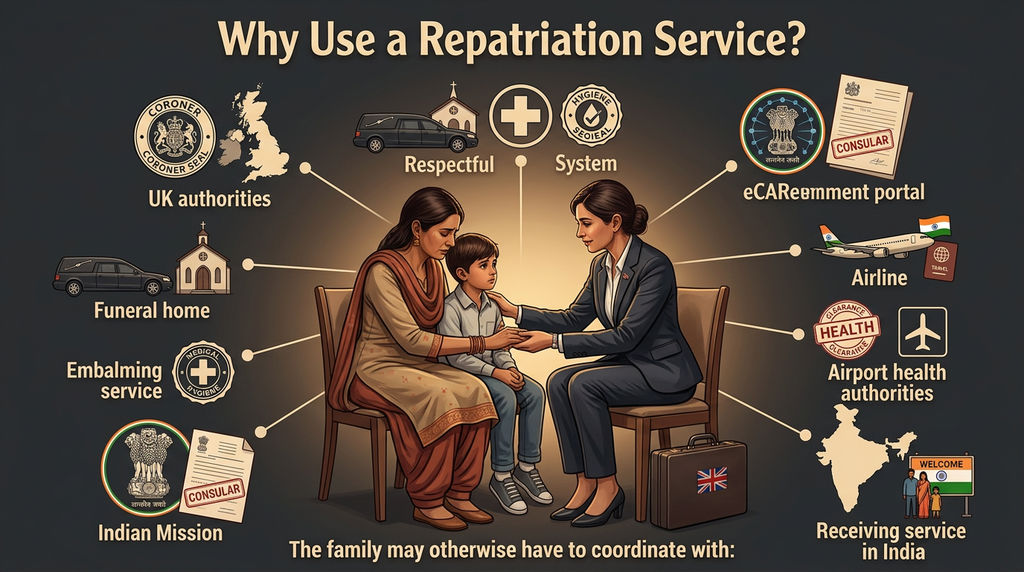
International repatriation involves several different organisations.
The family may otherwise have to coordinate with:
- UK authorities
- Funeral home
- Embalming service
- Indian Mission
- eCARe system
- Airline
- Airport health authorities
- Receiving service in India
A professional repatriation service can coordinate these different parts of the process.
This can be especially helpful when the family members are in India and cannot personally manage the arrangements in the UK.
How Beleiv Repatriation Can Help
Beleiv Repatriation can help families coordinate the transportation of mortal remains from the UK to India.
Support can include:
- Funeral director coordination
- Collection arrangements
- Documentation guidance
- Embalming coordination
- Consular formalities
- NOC-related assistance
- eCARe coordination
- Airline cargo arrangements
- Airport coordination
- Receiving arrangements in India
- Transportation to the final destination
The exact requirements depend on the circumstances of the death and the location in the UK.
The aim is to make the process easier for the family by coordinating the different arrangements involved.
Frequently Asked Questions
Can I bring mortal remains from the UK to India?
Yes. Mortal remains can be transported from the UK to India after completing the required UK, consular, health and airline formalities.
Is an NOC required?
An NOC from the relevant Indian Mission is part of the documentation required for transportation and clearance of eligible mortal remains in India.
Does the body need to be embalmed?
Generally, embalming and an embalming certificate are required for international transportation. The exact requirements should be confirmed for the individual case.
What documents are needed?
Common documents include the death certificate, embalming certificate, applicable coroner documentation, NOC, cancelled passport, packaging certificate, flight details and consignee information. The exact checklist can vary.
Can the family arrange the repatriation without a funeral director?
A funeral director or specialist repatriation service is strongly recommended because several formalities need to be coordinated. The High Commission of India in London specifically requires a funeral director or undertaker to complete the relevant transportation formalities.
How long does it take to bring mortal remains from the UK to India?
There is no fixed timeline. The time depends on the release of the deceased, documentation, consular procedures, preparation and airline availability.
What happens after the body reaches India?
The mortal remains undergo the applicable airport and public health clearance. Once permission is given, the deceased can be collected and transported to the final destination.
Final Thoughts
Bringing a loved one home from the UK to India involves several steps, but families do not have to figure everything out at once.
The basic process is:
- Complete the UK death formalities.
- Appoint a funeral director or repatriation service.
- Register the death with the Indian Mission.
- Collect the required documents.
- Apply for the NOC.
- Embalm and prepare the mortal remains.
- Complete the eCARe requirements.
- Arrange the airline transportation.
- Complete clearance after arrival in India.
- Transport the deceased to the final destination.
The most important thing is to start the process early and make sure the documentation is correct.
For a family already dealing with the loss of a loved one, professional coordination can take some of the practical burden away.
Beleiv Repatriation can help families coordinate UK-to-India mortal remains transportation, from the initial arrangements in the UK through to the final destination in India.