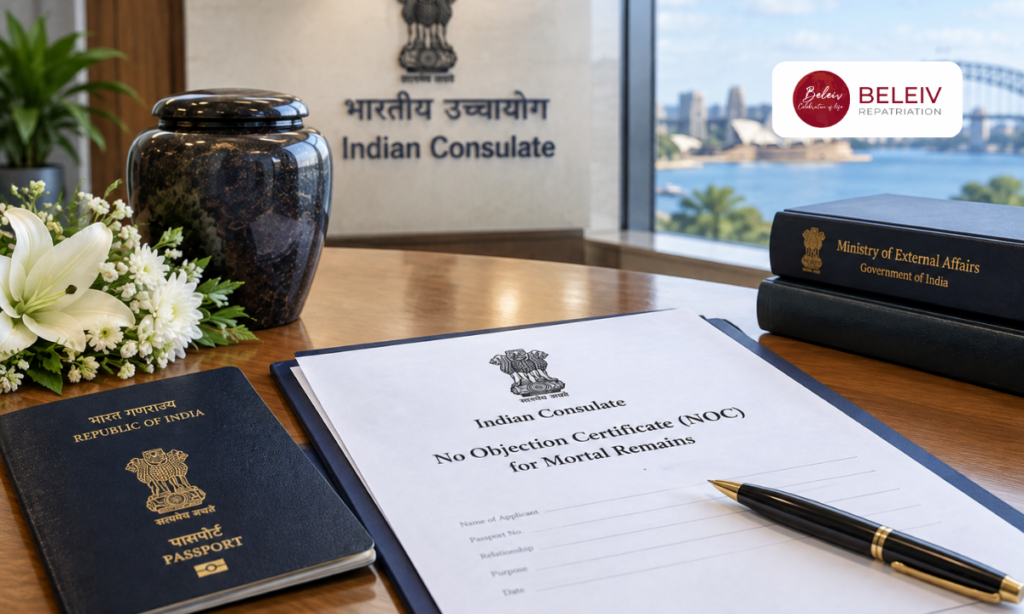
Learn how the Indian High Commission or Consulate supports the NOC process, which documents may be required, how eCARe clearance fits into the journey, and what families should prepare before transporting mortal remains to India.
Quick Answer
The Indian High Commission or Consulate in Australia issues a No Objection Certificate (NOC) after the applicable death and transport documents are reviewed and the required consular formalities are completed.
Depending on the case, the supporting file can include the death certificate, the deceased person’s passport, embalming and health-related certificates, funeral-home documents and transport details. After the consular process, the family or authorised representative must also complete India’s applicable public-health clearance through the eCARe portal before the remains are transported into India.
Important: The exact checklist and submission method can differ between Indian Missions in Australia and according to the circumstances of death. Confirm the current requirements with the Mission that has jurisdiction over the place of death.
Who Can Apply for the NOC?
The process can be handled by the next of kin or another person formally authorised by the family. In practical cases, the following may coordinate the documentation and submission:
• Next of kin or a close family member
• A relative or friend authorised by the family
• Employer or university representative, where applicable
• Funeral home or mortuary
• Professional repatriation agency acting with the family’s authorisation
When relatives are in India and cannot travel to Australia, an authorised local representative can help complete permitted formalities, subject to the Mission’s instructions.
Which Indian Mission Handles the Case in Australia?
Australia is served by the High Commission of India in Canberra and Consulates General of India in Sydney, Melbourne, Perth and Brisbane. The correct Mission depends on the Australian state or territory where the death occurred.
Victoria & Tasmania
Consulate General of India, Melbourne
Western Australia
Consulate General of India, Perth
Queensland
Consulate General of India, Brisbane
New South Wales & South Australia
Consulate General of India, Sydney
Australian Capital Territory
High Commission of India, Canberra
Northern Territory
Confirm the current jurisdiction with the responsible Indian Mission before applying.
Mission jurisdictions and service channels can change, so use the current official Mission instructions for the specific state or territory.
Step-by-Step Process to Get the NOC
1. Inform the relevant authorities. Notify the hospital, police or coroner if required, funeral home, and the Indian Mission/Post covering the Australian state or territory.
2. Appoint an authorised representative. If the family is in India, provide an authority letter authorising someone in Australia to coordinate the permitted formalities.
3. Arrange the death certificate and embalming documents. The funeral provider coordinates the required preparation and documentation, which may include embalming, coffin sealing and health certificates.
4. Submit the NOC application. Follow the exact online, appointment or in-person process prescribed by the responsible Indian Mission.
5. Surrender the deceased’s passport. The original Indian passport is submitted for the applicable cancellation and consular formalities.
6. Receive the Consulate or High Commission NOC. Once the documents are reviewed and the formalities are complete, the Mission issues the applicable NOC or certificate.
7. Apply for eCARe public-health clearance. Complete the Ministry of Health and Family Welfare’s eCARe process using the required documents and transport information.
8. Book airline cargo and transport the remains to India. The funeral home or repatriation agency coordinates cargo booking, airway bill, airport handling and arrival arrangements.
Documents Checklist for Transporting a Body
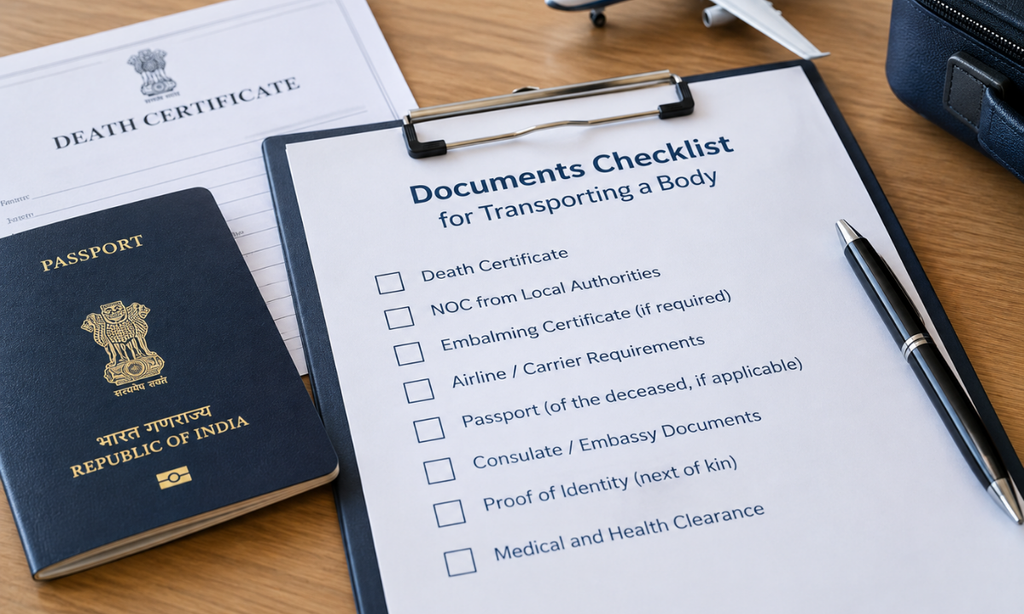
The final list should be confirmed with the relevant Indian Mission. Common requirements may include:
• Completed consular or miscellaneous service application form
• Deceased person’s original Indian passport, for cancellation
• Original Australian death certificate
• DFAT apostille or authentication, where the Mission requires it
• Embalmer’s or funeral parlour certificate confirming embalming and compliant coffin preparation
• Coffin-sealing or packaging certificate, where applicable
• Non-communicable-disease or other health certificate, where required
• Police, coroner or post-mortem documentation for accidental or unnatural deaths
• Authority letter from the next of kin when another person is handling the case
• Airline itinerary and accompanying-person details, if applicable
• Passport copy of the authorised or accompanying person, where required
• Applicable consular fee
Documents Checklist for Bringing Ashes to India
When the family chooses cremation in Australia and transports the ashes to India, the documentation is different from a full-body repatriation.
• Original death certificate
• Cremation certificate
• Deceased person’s passport for applicable cancellation formalities
• Request or authorisation letter
• Consular or miscellaneous service application form
• Applicable consular fee
• Ashes packaging or sealing documentation where required
Embalming and body-specific health certificates are generally not part of an ashes-only transport because the remains are already cremated. The Mission and airline should still be consulted for the exact documents before travel.
For dedicated ashes support, see Beleiv’s Asthi Repatriation service.
What Does the Indian Consulate NOC Cover?
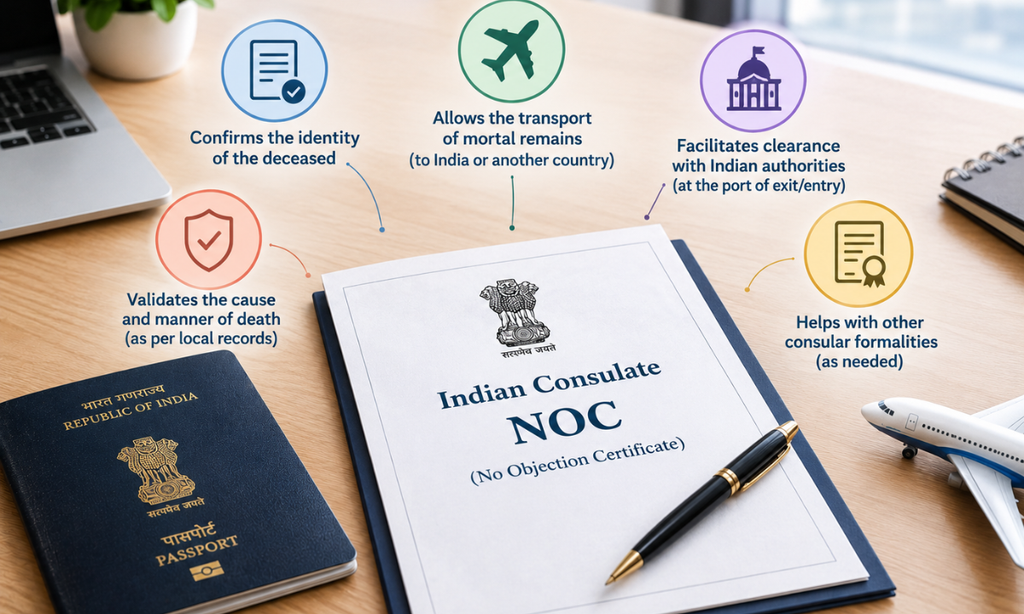
The NOC is part of the consular documentation used to support the transportation of mortal remains to India after the applicable formalities have been completed.
Depending on the case, the Indian Mission may also facilitate arrangements for local cremation or burial in Australia when that is the family’s chosen option and the required consent and documentation are in place.
The Mission’s role is primarily consular facilitation and coordination. It does not replace the funeral home, airline, cargo operator or repatriation provider that handles the physical preparation and transportation.
eCARe Clearance in India
Obtaining the Indian Mission NOC is not the only step. Human remains arriving in India are subject to the applicable public-health clearance process, which is handled electronically through the e-Clearance for Afterlife Remains (eCARe) system.
Typical eCARe information and documents
• Death certificate
• Indian Mission NOC
• Embalming and other applicable health documents
• Cancelled passport documentation
• Airport, airline and transport details
• Recipient or consignee information in India
The current eCARe process also supports ashes applications separately. The family, a relative in India, a funeral organisation, embalmer, Indian Mission or airline may assist with the application, depending on the case.
Costs and Who Pays
The NOC is only one part of the total repatriation cost. The family or authorised representative may need to arrange and pay for several services.
| Cost Area | What It May Include |
| Consular services | Applicable miscellaneous or certification fee charged by the Mission |
| Documents | Death certificate, apostille/authentication and other certificates where required |
| Funeral preparation | Embalming, coffin/casket, sealing and compliant preparation |
| Air transport | Airline cargo, airway bill, handling and airport charges |
| Local transport | Transfer from hospital or funeral home to the airport and from the Indian airport to the final destination |
| Repatriation service | Professional coordination, documentation support and logistics |
Possible funding sources include family members, employer support, insurance or eligible assistance schemes. The Indian Mission may facilitate the process but does not automatically pay all repatriation expenses.
Beleiv’s Repatriation Services From Australia to India page can be used as the main service link for families handling this process.
How Long Does the NOC and Repatriation Take?
There is no single fixed timeline for every case. A routine natural-death case can move more quickly when the documents are complete and the remains have already been released.
Timing can increase when there is:
• Police or coroner investigation
• Post-mortem or autopsy requirements
• Delay in the death certificate or other documents
• Apostille or authentication requirements
• Additional questions from the Indian Mission
• Limited airline cargo availability
• Corrections required in the eCARe application
The best approach is to obtain the current checklist from the responsible Mission and coordinate the funeral home, consular process and airline booking as one sequence.
Important Cautions Before Booking the Flight
• Confirm the correct Mission. Jurisdiction depends on the place of death.
• Ask for the latest checklist. Do not rely on an old PDF or another state’s checklist.
• Confirm apostille requirements. Ask whether each Australian document needs DFAT apostille or authentication.
• Confirm airline requirements. Ask about IATA-compliant preparation, sealing, cargo acceptance and airway bill requirements.
• Do not assume the NOC completes everything. eCARe and airline/public-health requirements still need to be satisfied.
• Keep copies of every document. Maintain both scanned and physical copies of certificates, passport records, NOC, receipts and transport paperwork.
Family Checklist: Australia to India
1. Confirm the death with the hospital, police or coroner as applicable.
2. Identify the Indian Mission with jurisdiction over the place of death.
3. Request the current mortal-remains NOC checklist.
4. Appoint an authorised representative if the family cannot travel.
5. Obtain the original death certificate and any required legalisation.
6. Complete local release and investigation formalities.
7. Arrange embalming and compliant coffin or casket preparation.
8. Submit the passport and consular documents.
9. Obtain the Indian Mission NOC.
10. Complete the eCARe application and clearance.
11. Confirm the airline booking and airway bill.
12. Arrange airport handling and final transportation in India.
Frequently Asked Questions
Is an Indian Consulate NOC mandatory?
For human-remains clearance, an NOC from the Indian Mission of the concerned country is part of the required documentation used in the eCARe process. Confirm the exact consular procedure with the Mission handling the Australian case.
Can ashes be brought to India instead of the body?
Yes. Ashes follow a separate documentation and transport process, and the current eCARe system supports ashes applications separately.
Does the death certificate need a DFAT apostille?
It may, depending on the Mission and the particular checklist. Confirm the requirement before paying for legalisation.
Can someone in India apply on behalf of the family?
A relative in India may be able to complete the eCARe application when they have the required information and document scans. Australian consular formalities may still require an authorised person locally.
Can a funeral home or repatriation agency handle the process?
Yes. A professional provider can coordinate funeral-home preparation, documents, airline cargo, airport handling and transportation while the Indian Mission completes the applicable consular role.
Does the Indian Mission pay for repatriation?
Not automatically. Expenses are generally handled by the family, employer, insurer or another eligible assistance arrangement.
Can the family choose cremation in Australia?
Depending on the circumstances and local law, local cremation may be possible. The family should complete the required consent, local formalities and Indian Mission documentation before proceeding.
Related Beleiv Services
Repatriation Services From Australia to India
Complete repatriation coordination for bringing mortal remains to India.
Dead Body Transportation Services
Transportation and logistics support for mortal remains.
Support for transporting cremated remains and ashes.
Dead Body Transportation in Bangalore
India-side transportation support for families in Bangalore.
Dead Body Transportation in Mumbai
Local transportation support after arrival in Mumbai.
Discuss the repatriation case and the next practical steps.
Need Help Bringing Mortal Remains From Australia to India?
When a family is managing a death abroad, the paperwork, funeral-home coordination and air-cargo process can be difficult to handle alone. Beleiv can help coordinate the practical repatriation steps while the relevant Indian Mission handles the applicable consular formalities.
View Australia-to-India Repatriation Services or Contact Beleiv.