

When an Indian citizen dies in the USA, the family has to deal with grief while also handling several legal, documentation, funeral and transportation requirements. If the family wants to bring the deceased back to India, the process involves coordination between local authorities in the USA, a funeral home, the Indian Consulate, airlines and authorities in India.
For families who are unfamiliar with international repatriation, the process can feel complicated. Knowing what happens at each stage can make it easier to plan the next steps.
This guide explains what happens when an Indian dies in the USA and how the mortal remains can be transported to India.
What Happens Immediately After an Indian Dies in the USA?
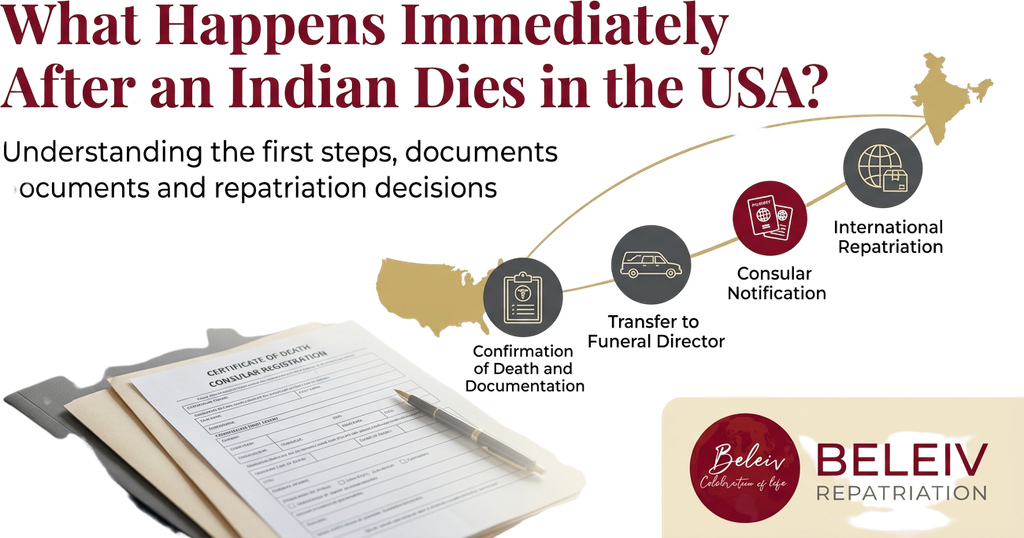
The first steps depend on where the death occurred and the circumstances surrounding it.
If the person dies in a hospital, the hospital usually completes the initial medical and administrative procedures. If the death is sudden, accidental or otherwise requires investigation, a medical examiner or coroner may become involved.
The family generally needs to:
- Obtain confirmation of the death.
- Contact the hospital, medical examiner or coroner, depending on the circumstances.
- Arrange for a funeral home to take custody of the deceased after release.
- Obtain the death certificate and other required documents.
- Decide whether the family wants local funeral arrangements or repatriation to India.
- Contact the appropriate Indian Consulate if the deceased was an Indian national.
The deceased cannot normally be transported internationally until the applicable local procedures have been completed.
Can an Indian Who Dies in the USA Be Brought Back to India?
Yes. Families can arrange the transportation of mortal remains from the USA to India after completing the required local, consular, health and airline procedures.
The Ministry of External Affairs explains that registration of the death with the concerned Indian Mission or Post is necessary for bringing the mortal remains of an Indian national back to India. The Mission can also coordinate with local authorities and assist with repatriation procedures.
The process is different from booking a normal international flight. The deceased must be prepared and transported according to applicable legal, health and airline requirements.
What Is the Role of the Indian Consulate?
The relevant Indian Consulate plays an important role in the repatriation process.
The Consulate can assist with:
- Registration of the death of an Indian national
- Verification and processing of required documents
- Issuing or facilitating the required NOC for transportation
- Coordination with local authorities where necessary
- Guidance regarding transportation of mortal remains
- Assistance in cases where the family needs support with the repatriation process
The correct Consulate depends on the location where the death occurred.
Families should therefore contact the Indian Mission or Consulate responsible for their area rather than relying on information from another jurisdiction.
What Documents Are Required to Bring Mortal Remains From the USA to India?
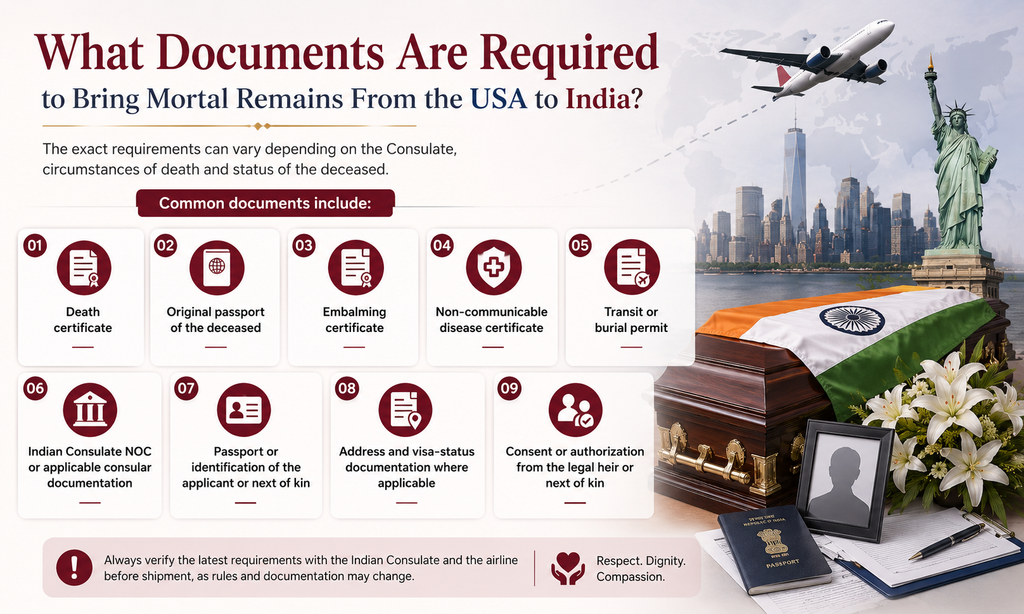
The exact requirements can vary depending on the Consulate, circumstances of death and status of the deceased.
Common documents include:
- Death certificate
- Original passport of the deceased
- Embalming certificate
- Non-communicable disease certificate
- Transit or burial permit
- Indian Consulate NOC or applicable consular documentation
- Passport or identification of the applicant or next of kin
- Address and visa-status documentation where applicable
- Consent or authorization from the legal heir or next of kin
The required documents should be confirmed with the Indian Consulate handling the case because requirements can vary depending on the circumstances.
Step-by-Step Process to Bring an Indian’s Mortal Remains From the USA to India
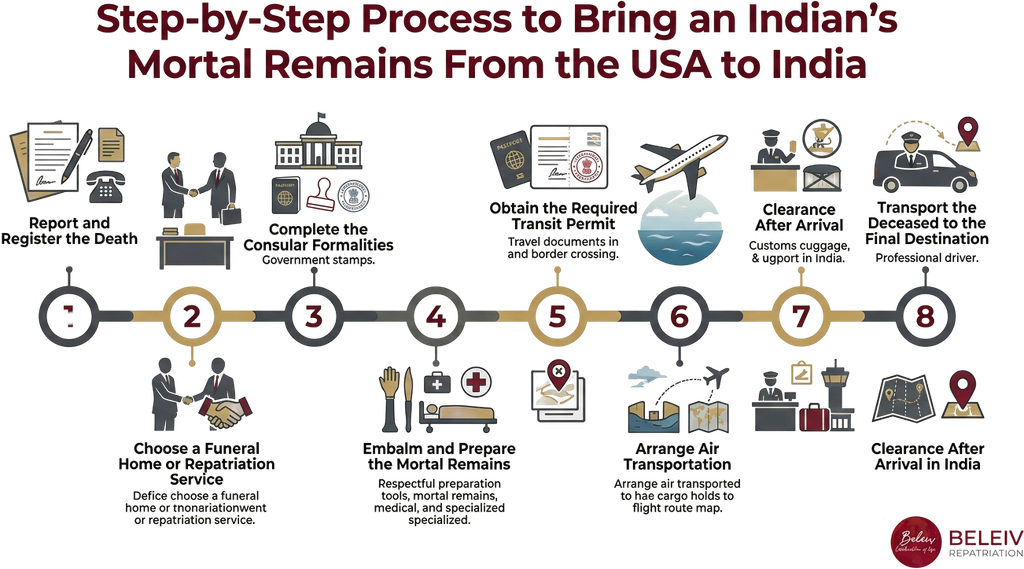
The repatriation process generally follows several stages.
Step 1: Report and Register the Death
The death must first be handled according to the local procedures in the US state where it occurred.
The family should obtain the official death certificate and complete any required procedures with the hospital, medical examiner or coroner.
For Indian nationals, the death also needs to be registered with the relevant Indian Mission or Post as part of the repatriation process.
Step 2: Choose a Funeral Home or Repatriation Service
The family normally works with a licensed funeral home in the USA.
The funeral home can help with:
- Taking custody of the deceased
- Embalming
- Preparing the casket
- Obtaining local certificates and permits
- Coordinating with the airline
- Preparing the deceased for international transportation
A specialist repatriation service can coordinate these arrangements with the Indian Consulate and the receiving family in India.
Step 3: Complete the Consular Formalities
The relevant Indian Consulate reviews the required documents and processes the applicable consular documentation.
Some Consulates require death registration to be completed before applications for transportation of mortal remains can be processed.
Families should check the specific requirements of the Consulate responsible for their location.
Step 4: Embalm and Prepare the Mortal Remains
For international transportation, the deceased is generally embalmed and prepared according to the applicable requirements.
The funeral home provides the embalming certificate and prepares the casket for transportation.
The packaging and preparation must meet the requirements applicable to international transportation and arrival in India.
Step 5: Obtain the Required Transit Permit
A transit or burial permit may be required before the deceased can be transported from the USA.
This document is part of the documentation used for international transportation.
The funeral home or repatriation service can help the family understand which permit is required and how it should be obtained.
Step 6: Arrange Air Transportation
Once the required documentation and preparation are completed, the repatriation service or funeral home coordinates transportation by air.
The arrangements may include:
- Airline cargo booking
- Airport transportation
- Cargo documentation
- Casket handling
- Coordination with the receiving party in India
The family should also arrange transportation from the arrival airport to the final destination in India.
Step 7: Clearance After Arrival in India
When the mortal remains arrive in India, they must undergo the applicable airport and public health clearance.
The family or receiving service may need to provide documents such as:
- Embalming certificate
- Death certificate mentioning the cause of death
- NOC from the Indian Embassy, High Commission or Consulate
- Cancelled passport
- Packaging certificate
- Consignee declaration
The casket cannot simply be removed from the airport without the required clearance.
Step 8: Transport the Deceased to the Final Destination
After airport clearance, the mortal remains can be transported to the family’s chosen destination.
This may involve:
- Airport-to-home transportation
- Transportation to a funeral home
- Transportation to a crematorium
- Transportation to a burial location
- Coordination with family members and local funeral service providers
Planning this part in advance can prevent unnecessary waiting after arrival.
Does the Body Have to Be Embalmed?
For international transportation of mortal remains, embalming is generally required and an embalming certificate is commonly part of the documentation.
There can be exceptions or different requirements in specific circumstances, such as certain deaths where embalming is not undertaken. In those cases, special sealed packaging and additional requirements may apply.
The funeral home and relevant authorities should confirm what applies to the individual case.
What Happens If the Death Was Accidental or Unnatural?
An accidental or unnatural death can take longer to process.
The reason is simple: local authorities may need to investigate the circumstances before releasing the deceased.
Additional documents may include:
- Police report
- Medical examiner or coroner documentation
- Cause-of-death documentation
- Additional authorization for release
- Other documents requested by the Consulate or local authorities
Families should therefore avoid assuming that every USA-to-India repatriation will take the same amount of time.
How Long Does It Take to Bring Mortal Remains From the USA to India?
There is no universal timeline.
The duration can depend on:
- US state and location of death
- Whether a medical examiner or coroner is involved
- Whether the death requires an investigation
- Time required to issue the death certificate
- Funeral home preparation
- Embalming
- Transit permit processing
- Indian Consulate processing
- Airline cargo availability
- Airport schedules
- Destination within India
A straightforward natural death may move through the process more quickly than an accidental or investigated death.
For this reason, families should obtain a case-specific estimate rather than relying on a fixed number of days.
What Happens If the Family Cannot Afford the Repatriation Cost?

The cost of bringing mortal remains from the USA to India can be difficult for some families to manage.
If the deceased had an insurance policy that covers repatriation, the insurance provider may arrange or pay for the transportation.
Families can also contact the appropriate Indian Consulate to ask whether any assistance may be available in their particular circumstances.
In certain situations, assistance may be considered based on the family’s financial circumstances and applicable government guidelines. However, such assistance is not automatic and depends on eligibility.
What Happens When the Mortal Remains Reach India?
Once the deceased reaches India, the family still needs to complete the final arrangements.
The usual sequence is:
- Airport and health clearance.
- Release of the mortal remains after the required permission.
- Transfer from the airport.
- Transportation to the final destination.
- Handover to the family or funeral service.
- Cremation or burial according to the family’s wishes.
The receiving arrangements should ideally be confirmed before the flight departs from the USA.
Can Ashes Be Brought From the USA to India Instead?
Yes. The process for transporting cremated ashes is different from transporting a complete body.
For ashes, the family may need documents such as:
- Death certificate
- Cremation certificate
- Passport of the deceased
- Consular documentation
- Identification and address proof of the applicant
Families should check the requirements of the relevant Indian Consulate before travelling with ashes.
Why Is Professional Repatriation Support Helpful?
When a loved one dies in another country, the family may be dealing with multiple authorities at the same time.
A professional repatriation service can help coordinate different parts of the process, including:
- Funeral home coordination in the USA
- Embalming arrangements
- Documentation
- Transit permits
- Consular coordination
- Airline cargo arrangements
- Airport coordination
- Transportation after arrival in India
- Communication with the family
This can be particularly helpful when family members are located in India and cannot personally manage every step in the USA.
How Beleiv Repatriation Can Help
Beleiv Repatriation helps families coordinate the transportation of mortal remains from the USA to India.
The team can assist families with the practical arrangements involved in international repatriation, including:
- Coordination with funeral homes
- Embalming arrangements
- Documentation support
- Consular coordination
- Transportation planning
- Airline coordination
- Airport arrangements
- Receiving arrangements in India
- Transportation to the final destination
Every case is different, so the exact requirements depend on the location of death, circumstances of death, nationality and documentation available.
If your loved one has passed away in the USA and the family wants to bring the mortal remains back to India, getting professional guidance early can help avoid unnecessary delays and confusion.
Frequently Asked Questions
What happens when an Indian dies in the USA?
The death is first handled according to the laws and procedures of the US state where the death occurred. The hospital, medical examiner, coroner or funeral home may be involved. If the family wants to bring the deceased to India, additional Indian Consulate, documentation, health and airline procedures are required.
Can the body of an Indian citizen be brought from the USA to India?
Yes. Mortal remains can be transported from the USA to India after completing the required local, consular, health and transportation formalities.
What documents are needed to bring a body from the USA to India?
Common documents include the death certificate, passport of the deceased, embalming certificate, non-communicable disease certificate, transit permit and applicable Indian Consulate NOC or documentation. Requirements can vary depending on the Consulate and circumstances of the case.
Is an Indian Consulate NOC required?
An NOC or applicable consular clearance is part of the documentation required for bringing human remains to India. Families should confirm the current requirements with the Indian Consulate handling the case.
Does the deceased need to be embalmed?
Generally, embalming is required for international transportation of mortal remains, and an embalming certificate is commonly required. Specific exceptions can apply depending on the circumstances.
Can ashes be brought from the USA to India?
Yes. The documentation and procedure for ashes are different from those for transporting a complete body. The family should check the requirements of the relevant Indian Consulate.
How long does USA-to-India body repatriation take?
There is no fixed timeline. Natural deaths with straightforward documentation may be processed differently from accidental or investigated deaths. Airline schedules, permits, consular processing and local procedures can also affect the timeline.
What if the family cannot afford to bring the body back to India?
Families can check whether insurance covers repatriation and contact the relevant Indian Consulate regarding possible assistance. Any financial assistance is subject to applicable rules and eligibility.
Final Thoughts
When an Indian dies in the USA, the family has to manage both an emotional loss and a complicated international process. Bringing the mortal remains back to India requires coordination between US authorities, a funeral home, the Indian Consulate, airlines and authorities at the Indian airport of arrival.
The main steps usually include:
- Completing the local death formalities.
- Obtaining the death certificate.
- Arranging a funeral home or repatriation service.
- Registering the death with the Indian Consulate.
- Completing the required documentation.
- Embalming and preparing the mortal remains.
- Obtaining the necessary permits and consular clearance.
- Arranging air transportation.
- Completing health and airport clearance in India.
- Transporting the deceased to the final destination.
Because requirements can vary depending on the US state and the relevant Indian Consular jurisdiction, families should verify the current requirements for their specific case.
Beleiv Repatriation can help coordinate the USA-to-India mortal remains transportation process and provide practical support to families throughout the arrangements.