

When a loved one passes away in Australia, one of the first questions families often have is, “How long will it take to bring the body back to India?”
The answer depends on several factors. International repatriation involves more than the flight itself. The deceased must be released by the relevant authorities, the required documents need to be prepared, embalming and coffin arrangements must be completed, consular formalities need to be handled, airline cargo must be booked, and clearance and transportation need to be arranged after arrival in India.
For a straightforward case, families should generally plan for several days rather than expecting the process to be completed within 24 or 48 hours. Beleiv’s current international cargo guidance indicates that the complete cargo process usually takes around 5 to 7 days, although the actual Australia-to-India timeline can be longer depending on documentation, release procedures, airline availability and other case-specific factors. International Airline Cargo Booking for Human Remains
Beleiv Repatriation can help coordinate the different stages involved in bringing mortal remains from Australia to India through its Repatriation Services From Australia to India.
How Long Does Australia to India Body Repatriation Take?

There is no fixed number of days that applies to every case.
A straightforward case may move faster when:
- The deceased has already been released.
- The death certificate is available.
- The required documents are ready.
- Embalming can be arranged quickly.
- Consular formalities can be completed without issues.
- Suitable airline cargo space is available.
- The receiving arrangements in India are already organised.
A case can take longer when there is:
- A coroner or police investigation
- Delay in releasing the deceased
- Missing or incorrect documents
- Delays in embalming or preparation
- Limited airline cargo availability
- Weekend or holiday schedules
- Additional transportation requirements in India
What Are the Main Stages That Determine the Timeline?
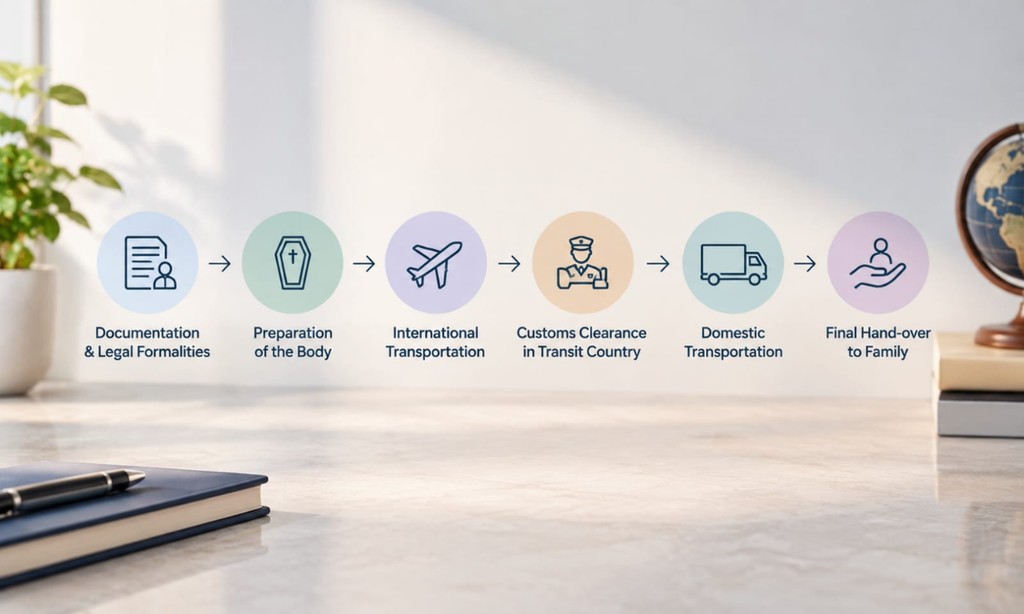
The total repatriation timeline is made up of several stages.
1. Release of the Deceased
The process begins after the death is registered and the deceased is released by the relevant hospital, police or coronial authority.
When the death is straightforward and there is no investigation, arrangements can generally move forward sooner.
However, if the death was sudden, accidental or otherwise requires investigation, the family may have to wait before the deceased can be released.
This is often one of the most important factors affecting the overall timeline.
2. Obtaining the Death Certificate
The death certificate is an important part of the repatriation documentation.
The time required can depend on the circumstances of the death and the authority responsible for issuing the certificate.
Families should make sure that the information on the certificate is accurate and matches the deceased person’s identification documents.
For more information about documentation, see Documents Required to Bring Mortal Remains From Australia to India.
3. Preparing the Required Documents
Several documents may need to be arranged before the mortal remains can be transported internationally.
Depending on the case, these can include:
- Death certificate
- Passport of the deceased
- Embalming certificate
- Health or non-infectious disease documentation
- Packaging and sealing documentation
- Family authorisation
- Consular forms
- Flight details
- Receiver or consignee details in India
- Coroner-related documents, where applicable
Missing or incorrect documents can delay the process because the next stage may not be able to proceed until the paperwork is corrected.
4. Indian Consulate Formalities
The family also needs to complete the applicable Indian Consulate or Mission formalities.
The time required depends on whether the application and supporting documents are complete.
It is important to understand that consular processing time is only one part of the overall repatriation timeline.
Even after the required consular documentation is obtained, the funeral director still needs to complete preparation and the airline cargo booking.
5. Embalming and Body Preparation
Once the deceased is released and the required arrangements can begin, embalming and preparation can be organised.
This may include:
- Embalming
- Dressing the deceased
- Preparing the coffin
- Sealing the coffin
- Obtaining the required certificates
- Completing transportation documentation
The time required depends on the funeral director, availability of the required documentation and the circumstances of the case.
6. Airline Cargo Booking
Airline cargo availability is another major factor.
Mortal remains are transported through specialised cargo arrangements, so families cannot always choose any flight they prefer.
The available options can depend on:
- Departure airport in Australia
- Arrival airport in India
- Airline
- Cargo capacity
- Flight schedule
- Connecting flights
- Documentation readiness
Beleiv’s International Airline Cargo Booking for Human Remains service includes coordination with suitable airlines, cargo space confirmation and airport handling.
7. Flight Transportation From Australia to India
The actual flight time is only one part of the overall process.
Even when a suitable flight is available, the deceased must first be accepted by the airline’s cargo process and all required documentation must be completed.
This means the total repatriation timeline should not be calculated simply by looking at the flight duration between Australia and India.
8. Clearance After Arrival in India
The process continues after the aircraft reaches India.
The mortal remains may need to go through the required airport and health-clearance procedures before they can be released to the receiving party.
Delays can occur when:
- Original documents are missing
- Details do not match
- Required documentation is incomplete
- The receiving arrangements have not been prepared
- Additional verification is required
Preparing these arrangements in advance can help reduce waiting time at the airport.
9. Transportation to the Final Destination
Once the mortal remains have been released, they may need to be transported from the arrival airport to another city or state.
For example, the family may be in Bengaluru while the international flight arrives in another Indian city.
The final journey may involve transportation to:
- Family residence
- Funeral home
- Crematorium
- Burial location
- Another city or state
Beleiv Repatriation also provides Dead Body Transportation Services for onward transportation within India.
How Long Does a Straightforward Case Take?
A straightforward case is one where:
- The deceased has been released without delay.
- There is no pending investigation.
- The death certificate is available.
- Required documentation is ready.
- Embalming can be completed promptly.
- Consular formalities do not face problems.
- Airline cargo space is available.
- The receiving arrangements in India are ready.
For planning purposes, families should think in terms of several days to around one or two weeks, rather than assuming that every case will be completed within a fixed number of days.
The exact timeline can only be estimated after the details of the individual case are known.
What Can Cause Delays?
Coroner or Police Investigation
If the death is sudden, accidental or otherwise under investigation, the deceased may not be released immediately.
Missing Documents
A missing passport, incorrect death certificate or incomplete documentation can hold up the process.
Embalming Delays
The funeral director may need additional time if preparation cannot begin immediately.
Airline Cargo Availability
There may not always be suitable cargo space on the preferred date.
Connecting Flights
A connecting route can require additional coordination compared with a more straightforward routing.
Weekends and Public Holidays
Government offices, funeral homes, consular services and airlines may operate on different schedules during weekends and public holidays.
Final Destination in India
If the family is located far from the arrival airport, additional road transportation needs to be arranged after arrival.
Can a Repatriation Service Speed Up the Process?
A repatriation service cannot control a coroner’s investigation, government processing or airline availability.
However, professional coordination can help reduce avoidable delays.
A repatriation service can coordinate:
- Funeral director arrangements
- Documentation
- Embalming
- Consular formalities
- Airline cargo
- Airport handling
- Receiving arrangements
- Transportation in India
This allows the family to have one point of coordination while the different stages are being completed.
What Can Families Do to Avoid Delays?
Families can take several practical steps at the beginning of the process.
Start the Process Early
Contact a funeral director or repatriation provider as soon as the deceased has been released or when the family knows that international repatriation will be required.
Keep Important Documents Ready
Keep the deceased person’s passport and other identification documents available.
Check Every Document Carefully
Names, dates, passport numbers and other information should be consistent across the documents.
Confirm the Destination
Decide where the deceased will be taken after arriving in India.
Arrange the Receiver in India
Make sure someone is available to receive the mortal remains at the destination airport.
Plan the Final Transportation
The vehicle for onward transportation should ideally be arranged before the flight arrives.
Does the Australian City Affect the Timeline?
Yes.
The location where the death occurs can affect the time required for collection and transportation to the departure airport.
For example, arrangements involving a major city with international cargo facilities may differ from a case where the deceased is located in a regional or remote area.
The actual location of death should therefore be provided to the repatriation coordinator when requesting a timeline.
Does the Indian Destination Affect the Timeline?
Yes.
The arrival airport and final destination can influence the overall process.
If the international flight arrives at an airport close to the family’s final destination, the last stage may be relatively simple.
If additional road transportation is needed, extra coordination and travel time will be required.
How Long Does It Take to Bring Ashes From Australia to India?
Transporting cremated ashes is different from transporting a body.
The process can involve different documentation, packaging and airline requirements.
Families choosing cremation in Australia should discuss the intended method of bringing the ashes to India before making travel arrangements.
What Information Does Beleiv Need to Estimate the Timeline?
To provide a more realistic estimate, a repatriation service may need:
- Australian city where the death occurred
- Current location of the deceased
- Date of death
- Cause or circumstances of death, where relevant
- Whether a coroner is involved
- Passport availability
- Death certificate status
- Embalming status
- Indian destination city
- Preferred arrival airport
- Details of the receiving person
Providing these details early helps the repatriation team identify potential delays.
How Beleiv Repatriation Can Help
Beleiv Repatriation can coordinate the different stages involved in bringing mortal remains from Australia to India.
Support can include:
- Collection arrangements
- Funeral director coordination
- Documentation assistance
- Embalming arrangements
- Consular coordination
- Airline cargo booking
- Airport handling
- Receiving arrangements in India
- Transportation to the final destination
Families can learn more about the service through Repatriation Services From Australia to India.
Australia to India Repatriation Timeline Checklist
Before the flight, the family should confirm:
- The deceased has been officially released.
- Death documentation is available.
- The passport and identification documents are available.
- Embalming has been completed.
- Required certificates are ready.
- Consular formalities are complete.
- Airline cargo is confirmed.
- Flight details are available.
- A receiver in India has been nominated.
- Airport clearance arrangements are ready.
- Transportation to the final destination has been arranged.
Frequently Asked Questions
How long does it take to bring a body from Australia to India?
There is no guaranteed timeline for every case. A straightforward case may take several days, while a more complicated case can take one or two weeks or longer.
Can a body be brought from Australia to India within 2 or 3 days?
It may be possible in an unusually straightforward case where the deceased has already been released, all documentation is ready and suitable airline cargo is immediately available. However, families should not assume this timeline.
What is the biggest reason for delays?
Delays can occur because of the release of the deceased, missing documents, investigations, embalming, consular formalities, airline cargo availability or airport clearance.
Does a coroner investigation delay repatriation?
It can. If the death is under investigation, the deceased may need to remain with the relevant authorities until the necessary procedures are completed.
How long does airline cargo transportation take?
The actual transportation depends on the flight route and airline schedule, but the overall repatriation process also includes documentation, preparation, cargo acceptance and clearance.
Does the process finish when the flight reaches India?
No. Airport and health-clearance procedures still need to be completed, followed by transportation to the final destination.
Can Beleiv coordinate the entire process?
Beleiv Repatriation can assist with documentation, preparation, airline cargo arrangements, airport coordination and transportation within India.
Final Thoughts
There is no single number of days that applies to every Australia-to-India body repatriation.
The timeline depends on:
- Release of the deceased
- Death certificate and other documents
- Coroner or investigation procedures
- Embalming and preparation
- Indian Consulate formalities
- Airline cargo availability
- Flight schedule
- Clearance in India
- Transportation to the final destination
As a general planning approach, families should allow several days and be prepared for the process to take longer when complications arise. Beleiv’s current international cargo guidance places the usual complete cargo process at around 5–7 days, but that should not be treated as a guaranteed Australia-to-India timeline. International Airline Cargo Booking for Human Remains
Beleiv Repatriation can help families coordinate the arrangements required to bring their loved one from Australia to India with clear communication throughout the process.