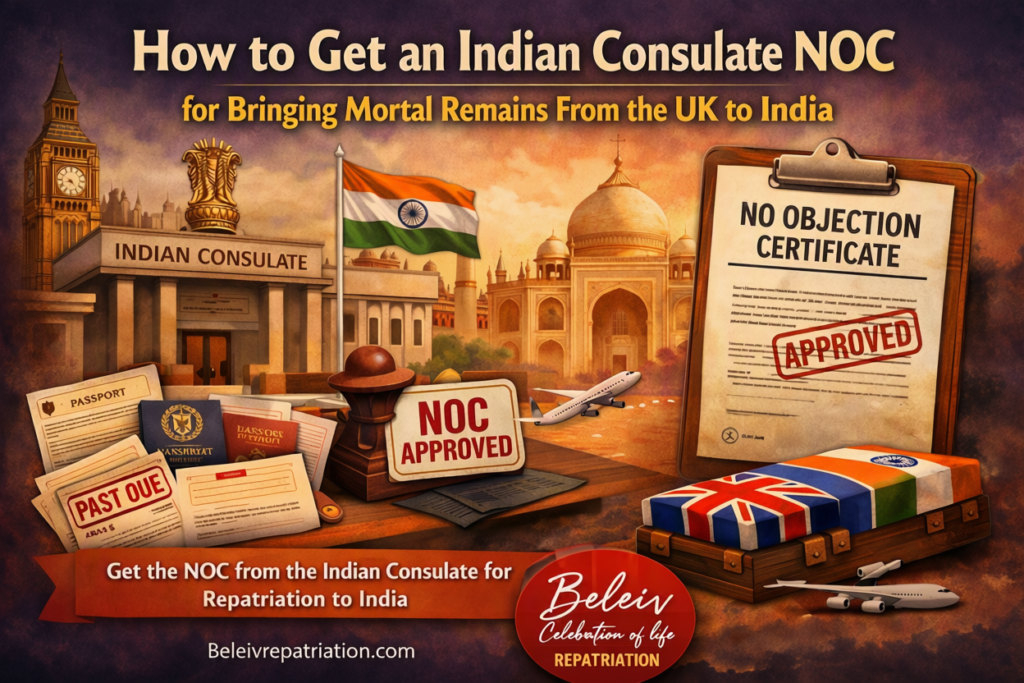
When an Indian citizen passes away in the UK, the family may want to bring the mortal remains back to India for the final funeral rites. One of the important documents needed for this process is the No Objection Certificate (NOC) from the Indian Mission.
For a family already dealing with a loss, the NOC process can seem confusing. There are documents to collect, UK formalities to complete, funeral arrangements to make and consular procedures to follow.
The good news is that the process becomes much easier when you understand what needs to be done and in what order.
This guide explains how to get an Indian Consulate NOC for bringing mortal remains from the UK to India, what documents are generally required and what happens after the NOC is issued.
What Is an NOC for Transportation of Mortal Remains?
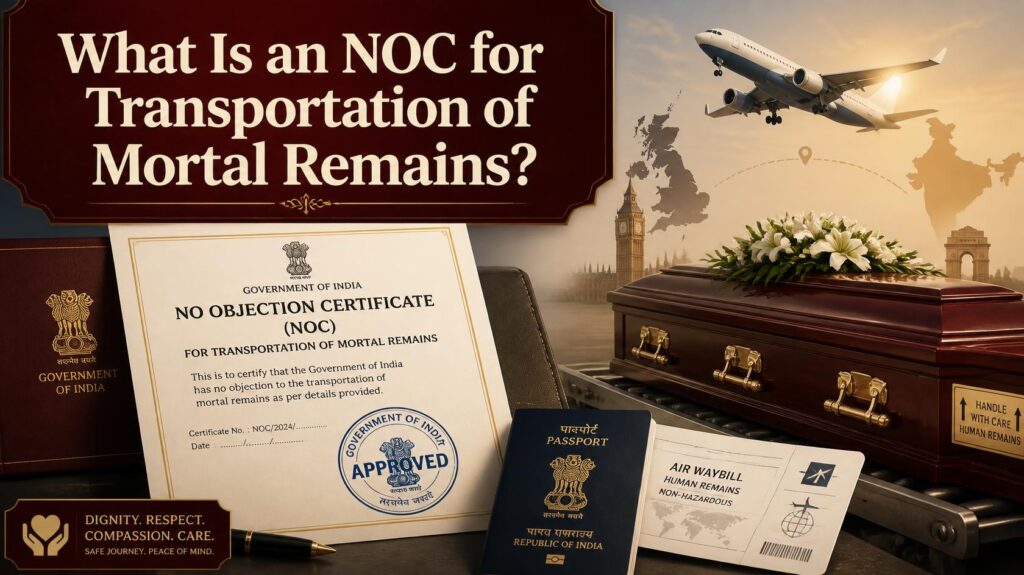
An NOC, or No Objection Certificate, is a consular document issued by the relevant Indian Mission for the transportation of eligible mortal remains to India.
The High Commission of India in London states that an NOC can be issued when the next of kin wishes to transport the mortal remains of a deceased Indian national, or a foreign national holding a valid OCI or PIO card at the time of death, to India for funeral or last rites.
The NOC is one part of the larger repatriation process. It does not replace the other UK, funeral, airline or Indian airport requirements.
Who Can Apply for the NOC?
The process can generally be handled by:
- The next of kin of the deceased
- A funeral director or undertaker authorized by the family
- An authorised representative, where applicable
The High Commission of India in London specifically states that the next of kin or an authorized Funeral Director/Undertaker may complete the required formalities.
For families, appointing a funeral director or specialist repatriation service can make the process much easier because the provider can coordinate the documentation and transportation arrangements.
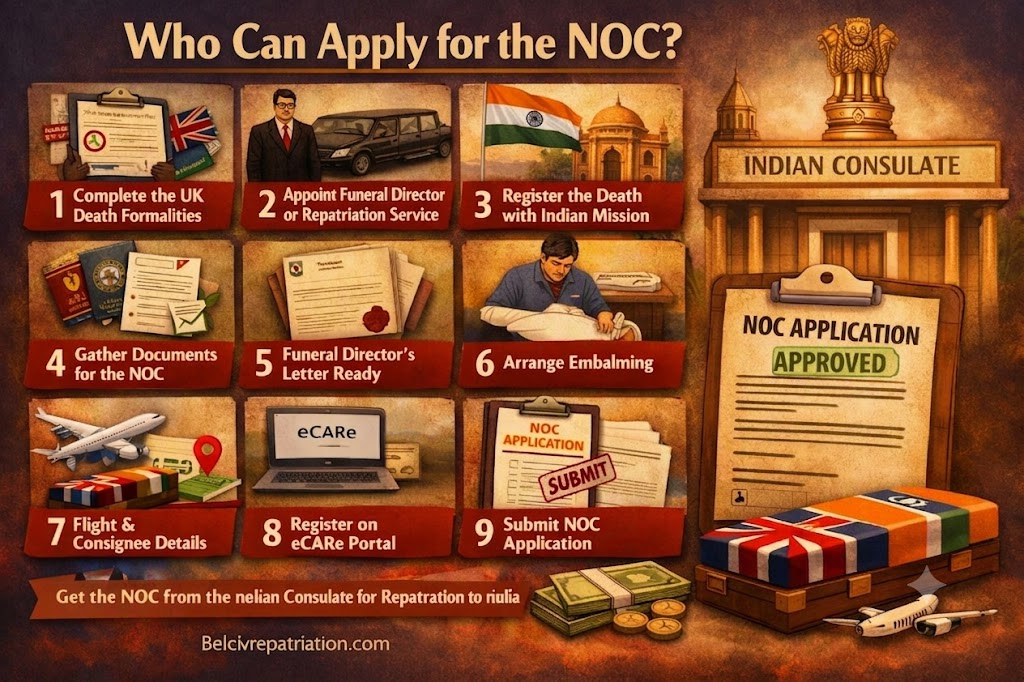
Step 1: Complete the UK Death Formalities
Before applying for the NOC, the necessary procedures in the UK need to be completed.
Depending on the circumstances of the death, this may involve:
- Hospital or medical authorities
- Local registration authorities
- Coroner
- Funeral director
- Other relevant UK authorities
If the death is sudden, unexpected or requires investigation, a coroner may need to complete additional procedures before the deceased can be released.
The family should wait until the necessary UK documentation is available before finalising the transportation arrangements.
Step 2: Appoint a Funeral Director or Repatriation Service
The next step is to appoint a funeral director or specialist repatriation service.
They can help with:
- Collecting the deceased
- Caring for the deceased
- Embalming
- Preparing the casket
- Obtaining the required certificates
- Coordinating with the Indian Mission
- Arranging airline transportation
- Preparing documents for the journey
- Coordinating the receiving arrangements in India
The High Commission of India requires a Funeral Director or Undertaker to complete the relevant transportation formalities.
Step 3: Register the Death With the Indian Mission
If the deceased was an Indian national, the death should be registered with the relevant Indian Mission.
The High Commission of India in London states that the next of kin should register the death by submitting the death certificate and the last-held Indian passport of the deceased.
It is important to complete this step properly because death registration and the NOC application are connected parts of the overall repatriation process.
Step 4: Gather the Documents for the NOC
This is where many families can experience delays, so it is worth checking everything carefully before submitting the application.
The High Commission of India in London currently lists documents including:
- Completed Miscellaneous Application Form
- Recent passport-size photograph
- Valid passport and identification of the applicant
- Proof of UK address
- Death certificate
- Coroner’s Out of England Order, where applicable
- Free From Infection Certificate
- Embalming certificate
- Certificate from the funeral director confirming that the mortal remains have been packed and sealed according to international regulations
- Flight details
- Name and contact details of the consignee in India
- Original passport of the deceased, where applicable
- OCI or PIO card, where applicable
- Documents relating to an escort, if someone is accompanying the mortal remains
- Required affidavit or undertaking where the mortal remains are travelling without an escort
The exact documentation can depend on the individual circumstances, so families should check the current requirements before submitting an application.
Step 5: Make Sure the Funeral Director’s Letter Is Ready
A letter from the Funeral Director or Undertaker is an important part of the application.
The High Commission’s requirements state that the funeral director should take responsibility for completing the required documentation and formalities, transporting the body to the final destination and communicating the arrival details to the next of kin or family.
This is another reason why working with an experienced repatriation provider can be useful.
Step 6: Arrange Embalming
The deceased generally needs to be embalmed before international transportation.
The funeral director provides the required embalming certificate.
The mortal remains also need to be appropriately packed and sealed for transportation.
The funeral director should ensure that the preparation meets the applicable UK and Indian requirements.
Step 7: Arrange the Flight and Consignee Details
The NOC process requires information about the intended transportation.
The family or funeral director may need to provide:
- Flight details
- Departure airport
- Arrival airport in India
- Name of the consignee
- Address of the consignee
- Telephone number of the consignee
The consignee is the person or authorised party who will receive the mortal remains in India.
It is important that these details are correct because they are also relevant to the clearance process after arrival.
Step 8: Register on the eCARe Portal
The High Commission of India currently requires the appointed Funeral Director, Undertaker or Next of Kin to register on the eCARe portal for transportation of mortal remains.
The eCARe system is designed to connect the different parties involved in the clearance process, including:
- Consignee
- Airport Health Organization
- Airline
- Funeral or repatriation service
- Other relevant stakeholders
Documents such as the following need to be uploaded through the system:
- Embalming certificate
- Death certificate
- NOC
- Cancelled passport
- Human remains packaging certificate
- Supporting documents, where requested
The original documents are also required to accompany the mortal remains for clearance at the Indian airport.
Step 9: Submit the NOC Application
Once the required documents are ready, the applicant can submit the NOC application according to the current procedure of the relevant Indian Mission.
For the High Commission of India in London, the current procedure requires applicants for the NOC to use the applicable consular application and appointment process.
Families should check the current appointment and submission requirements before travelling to the High Commission.
Step 10: Pay the Applicable Consular Fee
For an Indian passport holder, the High Commission of India in London currently lists the NOC for transportation of mortal remains as gratis, meaning there is no consular fee for the NOC itself.
For a foreign passport holder with OCI status, the listed fee is currently £16.
It is important to understand that a free NOC does not mean the overall repatriation is free.
The family may still need to pay for:
- Funeral director services
- Embalming
- Casket or packaging
- Documentation
- Airport transportation
- Airline cargo
- Airport handling
- Transportation in India
- Funeral arrangements
How Long Does the NOC Take?
The High Commission of India in London currently states that the processing time for the NOC is normally the same day, provided the required formalities and documents are complete.
However, families should not confuse the NOC processing time with the total repatriation timeline.
The overall process can take longer because of:
- Coroner procedures
- Release of the deceased
- Missing documents
- Embalming
- Funeral arrangements
- Airline availability
- Airport clearance
- Transportation arrangements in India
So, even if the NOC is issued on the same day, the mortal remains may not necessarily be able to travel to India immediately.
What Happens After the NOC Is Issued?
Getting the NOC is an important milestone, but there are still a few steps to complete.
The usual process is:
- NOC is issued.
- Required documents are uploaded to the eCARe system.
- Airline cargo arrangements are confirmed.
- Mortal remains are transported to the UK airport.
- Flight departs for India.
- Documents are reviewed at the Indian airport.
- Airport health clearance is completed.
- Mortal remains are released to the authorised consignee.
- The deceased is transported to the final destination.
The family should make sure the receiving arrangements in India are ready before the flight leaves the UK.
What Happens If Someone Accompanies the Mortal Remains?

Sometimes a family member or another person may accompany the mortal remains to India.
In such cases, additional documentation may be required.
The High Commission’s requirements include passport copies and a written undertaking from the person accompanying the mortal remains. If the person is not a relative, additional consent from the next of kin may be required.
The funeral director should confirm the exact requirements before travel.
What If Nobody Accompanies the Mortal Remains?
Mortal remains can also be transported without an escort, subject to the applicable requirements.
In such cases, the next of kin or family member receiving the deceased in India may need to provide an affidavit or undertaking accepting responsibility for collecting the mortal remains at the airport.
The receiving person’s identification documents may also be required.
What If the Death Was Under Coroner Investigation?
If a coroner is involved, the family may have to wait until the relevant procedures are completed.
This can delay the NOC application because some of the required documents may not yet be available.
For example, the High Commission lists the Coroner’s Out of England Order among the documents required for the NOC application.
In these cases, it is better to let the funeral director coordinate with the relevant authorities rather than trying to arrange the flight before the deceased is released.
What If the Family Cannot Afford the Repatriation?
Not having insurance does not automatically prevent a family from bringing the deceased back to India.
Families can check:
- Existing insurance policies
- Employer benefits
- Death-in-service benefits
- Travel insurance
- Assistance available through the Indian Mission
The High Commission of India in London states that the Indian Community Welfare Fund may provide assistance for transportation of mortal remains in certain situations where the employer, sponsor or insurance company is unable or unwilling to cover the cost and the family cannot meet the expenses.
Such assistance depends on eligibility and applicable guidelines.
Common Mistakes Families Should Avoid
When dealing with a death abroad, small mistakes can create unnecessary delays.
Try to avoid:
- Booking a flight before the deceased is released.
- Submitting incomplete documents.
- Using incorrect consignee details.
- Waiting until the last minute to start consular formalities.
- Assuming the NOC is the only document required.
- Forgetting to arrange transportation after arrival in India.
- Assuming airline charges are included in a funeral director’s quotation.
- Relying on outdated information about consular requirements.
Requirements can change, so the current instructions should always be checked before submitting an application.
How Beleiv Repatriation Can Help
For a family dealing with the loss of a loved one, handling the NOC and other formalities can feel overwhelming.
Beleiv Repatriation can help coordinate the UK-to-India repatriation process and assist with the practical arrangements involved.
Support can include:
- Funeral director coordination
- Document collection
- Embalming arrangements
- Consular coordination
- NOC-related assistance
- eCARe coordination
- Airline cargo arrangements
- Airport coordination
- Consignee arrangements in India
- Transportation to the final destination
Instead of having to manage each part of the process separately, the family can have a repatriation service coordinate the different arrangements.
Frequently Asked Questions
What is an NOC for bringing mortal remains to India?
An NOC, or No Objection Certificate, is a document issued by the relevant Indian Mission for the transportation of eligible mortal remains to India for final funeral rites.
Who can apply for the NOC?
The next of kin can apply, or an authorised funeral director or undertaker can complete the formalities on behalf of the family.
What documents are needed for the NOC?
Documents can include the death certificate, applicant’s passport and address proof, coroner documentation where applicable, Free From Infection Certificate, embalming certificate, packaging certificate, deceased person’s passport, flight details and consignee information.
How long does the NOC take?
The High Commission of India in London currently states that NOC processing is normally completed the same day when the application and required documents are complete.
Is the NOC free?
For an Indian passport holder, the NOC is currently listed as gratis by the High Commission of India in London. A fee currently applies for eligible foreign passport holders with OCI status.
Do I need a funeral director?
The High Commission requires a Funeral Director or Undertaker to complete the relevant transportation formalities, although the next of kin may also complete applicable procedures.
What is eCARe?
eCARe is an online system used to coordinate the clearance of mortal remains and connect relevant stakeholders involved in the transportation process.
Can the mortal remains travel without an escort?
Yes, subject to the applicable requirements. The receiving family member may need to provide an affidavit or undertaking accepting responsibility for collecting the mortal remains in India.
Final Thoughts
Getting an Indian Consulate NOC is an important part of bringing mortal remains from the UK to India, but it is only one part of the complete repatriation process.
The basic process is:
- Complete the UK death formalities.
- Appoint a funeral director or repatriation service.
- Register the death with the Indian Mission.
- Collect the required documents.
- Complete embalming and preparation.
- Register on the eCARe portal.
- Apply for the NOC.
- Arrange the airline transportation.
- Complete clearance after arrival in India.
- Transport the deceased to the final destination.
The current High Commission of India guidance states that NOC processing is normally same day when the required documents and formalities are complete, but the overall repatriation timeline can still vary depending on the circumstances of the death and transportation arrangements.
For families already dealing with a difficult loss, professional coordination can make the process much easier.
Beleiv Repatriation can help families coordinate the UK-to-India mortal remains repatriation process, including documentation, consular formalities, NOC assistance, airline arrangements and transportation in India.