
When a loved one passes away in the United States and the family wants to bring the mortal remains back to India, documentation is one of the most important parts of the process. Repatriation services from USA to India can help families coordinate the required paperwork and transportation arrangements.
The paperwork may involve the funeral home, U.S. local authorities, the relevant Indian Consulate, airline or cargo provider, health authorities and the receiving team in India.
For families in New York, New Jersey, Dallas, Houston, Chicago, San Jose, Fremont, Los Angeles, Atlanta, Seattle or other U.S. cities, the exact requirements can vary depending on where the death occurred and which Indian consular jurisdiction handles the case.
This is why there is no single universal checklist that should be followed blindly.
The safest approach is to identify the deceased person’s nationality, the exact U.S. location of death and the intended destination in India before finalizing the documentation.
Quick Checklist: Documents Usually Required
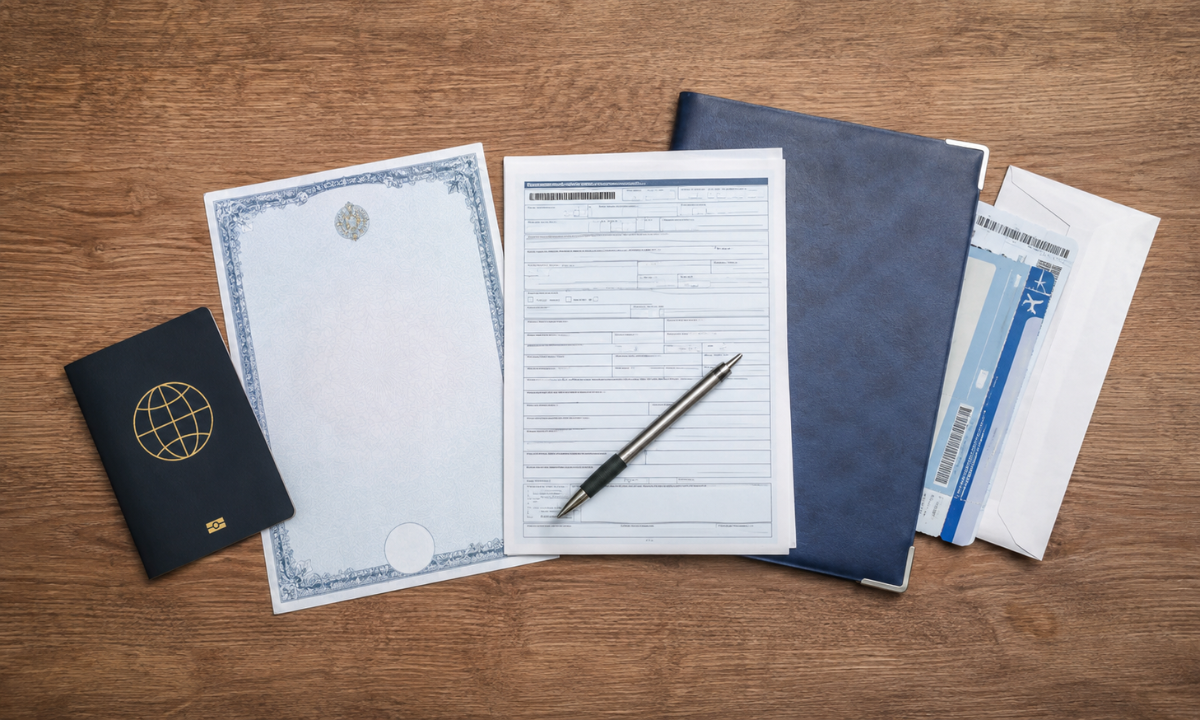
For a straightforward mortal-remains repatriation case, the documentation may include:
- Original death certificate
- Passport of the deceased
- OCI card, where applicable
- Passport and identification of the relative or informant
- Proof of address of the relative or informant
- Embalming certificate
- Health or non-communicable disease certificate
- Transit or burial permit
- Consular documentation or No Objection Certificate, where applicable
- Airline or cargo documentation
- Additional documents requested by the airline, funeral home or relevant authority
For example, the Consulate General of India in San Francisco currently lists the deceased person’s passport and death certificate, the informant/relative’s passport and proof of address, and, specifically for mortal remains, a non-communicable disease certificate, embalming certificate and transit permit.
The Consulate General of India in Houston similarly lists the death certificate stating the cause of death, embalming certificate, infection-free certificate and burial/transit permit for transportation of mortal remains.
1. Death Certificate
The death certificate is one of the most important documents in the entire repatriation process.
It should be obtained from the appropriate U.S. authority responsible for registering the death.
The document generally needs to establish:
- Full name of the deceased
- Date of death
- Place of death
- Cause of death, where required
- Other relevant identifying information
The Houston Consulate specifically states that the death certificate for carrying mortal remains should clearly state the cause of death.
Check the details carefully
Before submitting the certificate, compare the name and other personal information with the deceased person’s passport.
A small spelling difference may create unnecessary documentation questions later.
For example, check:
Passport:
Ramesh Kumar Sharma
Death certificate:
Ramesh K. Sharma
Even seemingly minor differences should be discussed with the funeral home or repatriation coordinator before proceeding.
2. Passport of the Deceased
If the deceased was an Indian citizen, the Indian passport is an important part of the consular documentation.
The Houston Consulate currently states that the original passport of a deceased Indian national and a photocopy are required and that the passport needs to be cancelled as part of the death-related process.
Keep the original passport available rather than sending only a scanned copy unless the relevant authority specifically instructs otherwise.
If the deceased was a U.S. citizen, OCI holder or another nationality, the documentation may be different.
This is why the first question a repatriation provider should ask is:
“What was the nationality and passport status of the deceased?”
3. OCI Card, If Applicable
If the deceased was a U.S. citizen of Indian origin and held an OCI card, include the OCI documentation.
The requirements can differ from those for an Indian passport holder.
The San Francisco Consulate currently publishes separate requirements for Indian passport holders, U.S. passport holders with OCI and U.S. passport holders.
This distinction is important because families sometimes assume that an OCI holder will follow exactly the same documentation process as an Indian passport holder.
4. Passport of the Relative or Informant
The person handling the documentation may need to provide their own passport and identification.
The San Francisco Consulate currently lists the passport of the informant or relative along with proof of address.
The Houston Consulate similarly requires the applicant’s passport and copy. If a funeral-home representative handles the documentation, Houston states that the representative may submit identification and an authorization letter from the funeral home.
This can be especially useful when the immediate family is in India while the death occurred in New Jersey, Texas, California, Illinois or another U.S. state.
5. Proof of Address
The relative or person handling the documentation may also need to provide proof of U.S. residence.
Depending on the consular jurisdiction, acceptable documents can include items such as:
- U.S. driver’s license
- State identification card
- Utility bill
- Lease agreement
- Mortgage-related document
The Houston Consulate currently lists U.S. driver’s license, utility bill, lease agreement, state identity card or mortgage deed as examples of residence proof.
Because acceptable documents can vary, verify the current checklist of the relevant consular jurisdiction.
6. Embalming Certificate
The embalming certificate confirms that the deceased has undergone the required preparation for transportation.
It is generally issued by the funeral home or relevant local authority involved in the preparation.
Current Indian consular guidance identifies the embalming certificate as part of the documentation for transportation of mortal remains.
Why this document matters
Families sometimes think that completing embalming is enough.
It is not necessarily enough.
The certificate documenting the embalming can also be required as part of the repatriation paperwork.
The funeral home should therefore be told from the beginning that the deceased will be transported internationally to India.
That helps ensure the preparation and supporting documentation are handled with international transportation in mind.
7. Health or Non-Communicable Disease Certificate
A health-related certificate may also be required.
For example, the San Francisco Consulate currently requires a non-communicable disease certificate from the Health Department for transportation of mortal remains.
Houston’s current guidance refers to a certificate from the concerned local authority stating that the body is free from infection.
Notice that the terminology differs between jurisdictions.
That is another reason not to copy a checklist from another U.S. city and assume it applies everywhere.
8. Transit or Burial Permit
A transit permit or burial permit may be required before mortal remains can be transported.
The exact name of the document and the issuing authority can depend on the state and local jurisdiction where the death occurred.
For example, current Indian Consulate guidance in both San Francisco and Houston identifies a transit or burial permit as part of the documentation for mortal-remains transportation.
The funeral home handling the case will generally be involved in obtaining the appropriate local permit.
9. Indian Consular Application or No Objection Process
The Indian Consulate may require an application for death registration and/or authorization related to transporting the mortal remains to India.
The exact process depends on the deceased person’s nationality and the consular jurisdiction.
For example, the Houston Consulate’s official application form is specifically titled for registration of death and obtaining a No Objection Certificate to carry mortal remains to India.
The important point is that the family should identify the correct Indian Consulate before preparing the final submission.
The relevant jurisdiction is determined by where the death occurred, not simply where the family lives.
10. Death Registration With the Indian Consulate
For an Indian national who dies in the USA, death registration with the relevant Indian mission can be part of the process.
The current San Francisco procedure instructs applicants to register the death through the Indian government’s eSEWA platform before applying for transportation of mortal remains or ashes.
The process can involve online document submission and subsequent handling of original documents depending on the jurisdiction.
This is an important distinction:
Submitting documents online does not necessarily mean the entire repatriation process is completed online.
Always follow the current instructions issued by the specific Indian mission.
11. Application Form
Some consular jurisdictions require a specific application form.
For example, Houston provides an application form covering registration of death and a No Objection Certificate for carrying mortal remains or ashes to India.
The application may ask for information such as:
- Full name of deceased
- Date and place of birth
- Nationality
- Passport information
- Legal status in the USA
- Date and place of death
- Cause of death
- Manner of death
- Destination in India
- Information about the applicant
The application should be completed carefully because inconsistencies between the form and supporting documents can lead to additional questions.
12. Funeral Home Authorization, If a Representative Handles the Case
The person handling the paperwork does not always have to be an immediate family member.
In some cases, a funeral-home representative may submit documents on behalf of the family.
Houston’s current guidance states that when documentation is handled through a funeral home, its representative may submit identification and a signed authorization letter issued by the funeral home.
This can be helpful when family members are located far away.
For example, relatives may be in Bangalore or Hyderabad while the deceased is at a funeral home in Dallas or Houston.
13. Airline and Cargo Documents
Consular documents are only one part of the paperwork.
The airline or cargo provider may have additional requirements.
The San Francisco and Houston Consulates both advise applicants to check with the airline for additional documentary requirements.
These requirements can relate to:
- Cargo booking
- Packaging
- Acceptance procedures
- Flight routing
- Handling
- Documentation accompanying the remains
Therefore, don’t assume that obtaining consular clearance automatically means the airline is ready to accept the shipment.
The consular side and airline side need to be coordinated.
14. eCARe Public Health Clearance

One particularly useful part of the modern repatriation process is India’s e-Clearance for Afterlife Remains (eCARe) system.
The Indian Ministry of Health and Family Welfare developed eCARe to streamline public-health clearance for transporting human remains to India.
The system is designed to connect stakeholders including the consignee, Airport Health Organization and airlines and provides online processing, alerts and status tracking.
This means that families and repatriation providers should not think of the process as entirely paper-based.
Some parts of the clearance process now involve digital systems.
15. What If the Death Was Accidental?
An accidental, unnatural or suspicious death can require additional documentation.
A medical examiner, coroner or police authority may need to complete its investigation before the deceased can be released.
The Ministry of External Affairs’ consular guidance indicates that police reports can be required in cases of unnatural death in relevant jurisdictions.
The important practical point is:
Do not try to move the case forward as if it were a routine death when an investigation is still pending.
The repatriation coordinator should first determine whether the remains have been legally released.
16. What If the Deceased Died in New York, New Jersey, Texas or California?
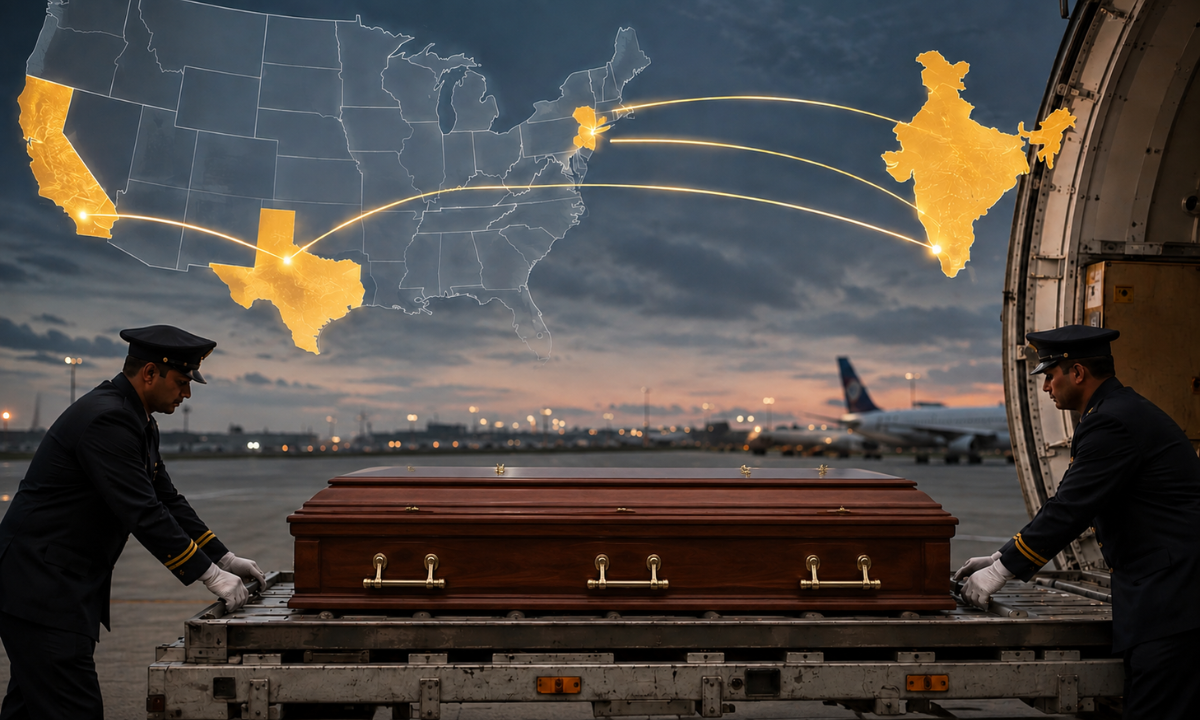
The documentation may look similar, but the actual process can vary.
For example:
New York / New Jersey
A family may be arranging transportation from:
- New York City
- Newark
- Jersey City
- Edison
- Iselin
- Princeton
- Other New York/New Jersey communities
Texas
Common locations include:
- Dallas
- Frisco
- Plano
- Irving
- Houston
- Sugar Land
- Katy
California
Cases may originate from:
- San Jose
- Fremont
- Sunnyvale
- Santa Clara
- San Francisco
- Los Angeles
- Anaheim
Illinois
- Chicago
- Naperville
- Schaumburg
- Other surrounding communities
The exact city and state of death should always be provided to the repatriation service because local documentation and consular jurisdiction can depend on it.
17. What Documents Should Be Sent With the Remains?
The exact document package should be confirmed with the funeral home, airline, health authority and relevant Indian mission.
A typical document package may contain:
| Document | Usually Involved |
|---|---|
| Death certificate | Yes |
| Deceased’s passport | Often required |
| OCI card | If applicable |
| Relative/informant passport | Often required |
| Proof of address | May be required |
| Embalming certificate | For mortal remains |
| Health/non-communicable disease certificate | Depending on jurisdiction |
| Transit/burial permit | For transportation |
| Consular application | Where required |
| NOC/consular clearance | Where applicable |
| Airline/cargo documentation | Required by carrier |
| eCARe/public health clearance | Applicable cases |
This table should be treated as a planning checklist, not a universal legal checklist.
Requirements can change.
The Most Common Documentation Mistakes
Mistake 1: Using an old consular checklist
Government requirements can change.
For example, current consular procedures now include digital systems such as eSEWA in some jurisdictions and eCARe for public-health clearance.
Mistake 2: Checking only the death certificate
The death certificate is important, but it is only one part of the document package.
Mistake 3: Ignoring the airline’s requirements
Consular approval and airline cargo acceptance are separate parts of the process.
Mistake 4: Not checking the deceased’s nationality
An Indian passport holder, OCI holder and U.S. citizen may have different documentation requirements.
Mistake 5: Waiting until the last minute
Documents can require correction, verification, signatures or additional information.
Starting early gives the family more room to solve problems.
A Better Way to Organize the Documents
Instead of keeping every document in one folder, divide the case into four groups.
Group 1: Deceased
- Passport
- OCI card, if applicable
- Death certificate
Group 2: Funeral Home
- Embalming certificate
- Health certificate
- Transit/burial permit
- Other preparation documents
Group 3: Family/Informant
- Passport
- Proof of address
- Authorization documents where applicable
Group 4: Transportation & Clearance
- Consular application
- NOC/consular documentation
- Airline documents
- eCARe/public-health clearance
- Destination information
This makes it much easier to identify what is missing.
What Should Families Do First?
If the death has just occurred, don’t wait until every document is available before contacting a repatriation professional.
Start with these details:
- Full name of deceased
- Date of death
- City and state of death
- Current location of remains
- Nationality
- Passport/OCI status
- Funeral home details
- Intended destination in India
- Whether the death is under investigation
- Whether a death certificate is available
With these details, the repatriation coordinator can help identify the appropriate next steps.
What Beleiv Repatriation Can Help Coordinate
For families arranging transportation from the USA to India, Beleiv Repatriation can coordinate the different parts of the process rather than leaving the family to manage each organization separately.
Depending on the case, this can involve coordination between:
Family → Funeral Home → Local Authorities → Indian Consulate → Health Clearance → Airline/Cargo → India Receiving Team
This can be particularly useful when relatives are in India while the death has occurred in the USA.
For example:
New Jersey → Kerala
Dallas → Hyderabad
San Jose → Bangalore
Chicago → Mumbai
The documentation requirements need to be checked for the actual place of death and the deceased person’s status.
Final Document Checklist
Before the mortal remains leave the USA, confirm that the case has the required document checklist, including:
- Death certificate
- Passport of deceased
- OCI card, if applicable
- Relative/informant identification
- Proof of address
- Embalming certificate
- Health/non-communicable disease certificate
- Transit/burial permit
- Consular application
- Required NOC or consular clearance
- Airline/cargo documentation
- Applicable public-health/eCARe clearance
- India destination and receiving information
Final Thoughts
The documents required to send mortal remains from the USA to India are not simply a single fixed list.
The requirements can depend on:
Where the death occurred + nationality of the deceased + circumstances of death + Indian consular jurisdiction + airline + destination in India.
Current official guidance demonstrates why this matters. San Francisco and Houston, for example, publish requirements that overlap but are not identical, while systems such as eSEWA and eCARe have added digital components to parts of the process.
The safest approach is therefore to verify the current requirements for the specific case before the funeral home and airline arrangements are finalized.
Whether the deceased is being transported from New York, New Jersey, Dallas, Houston, Chicago, San Jose, Fremont, Los Angeles or another U.S. city to Bangalore, Hyderabad, Chennai, Mumbai, Delhi, Kerala or another destination in India, the documentation should be coordinated from the beginning.
At Beleiv Repatriation, the objective is to help families manage this process with fewer complications through reliable Repatriation services in India, including coordination of documentation, funeral-home arrangements, the consular process, transportation and India-side reception.
If you need to bring mortal remains from the USA to India, contact Beleiv Repatriation with the city and state of death, nationality of the deceased and intended destination in India. These three details are a useful starting point for determining the next steps.
Important: Repatriation requirements can change and may differ by U.S. state, Indian consular jurisdiction, airline and individual circumstances. Always confirm the current requirements with the relevant authorities and transportation providers before making final arrangements.