
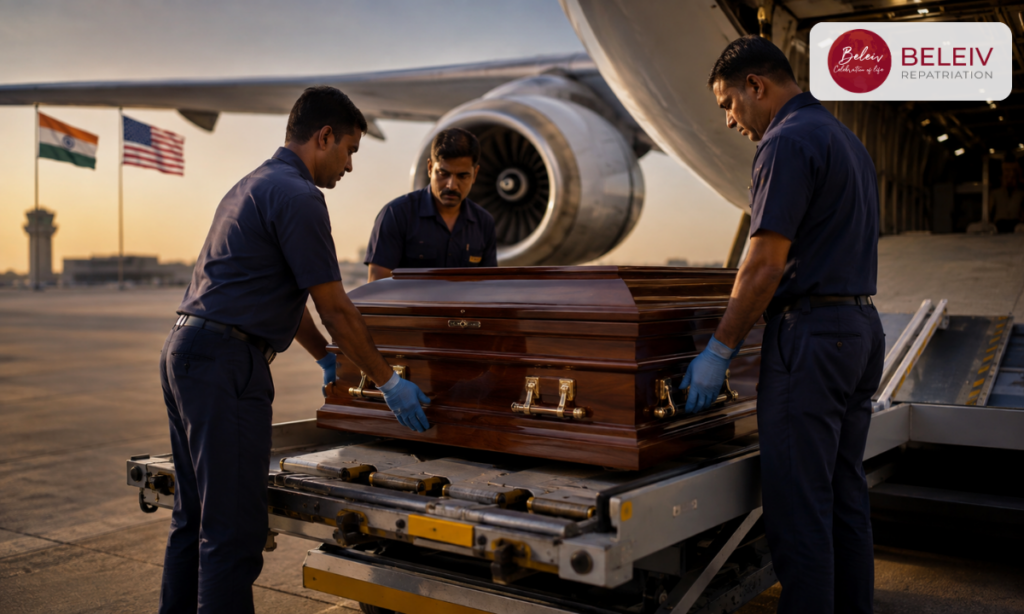
When a loved one passes away in the United States, and the family wants to bring the deceased back to India, the process can feel overwhelming. There are funeral-home arrangements, government documents, embalming, permits, consular requirements, airline coordination, and arrangements waiting in India.
For an Indian family living in New York, New Jersey, Dallas, Houston, Chicago, the San Francisco Bay Area, Los Angeles, Washington, Atlanta, or Philadelphia, the first challenge is often knowing where to begin.
The difficult part is not simply transporting the body from one country to another.
The real challenge is coordinating several steps in the correct order while the family is dealing with grief and time-sensitive decisions.
This guide explains how to bring a dead body from the USA to India, what documents are generally required, where delays can happen, and how professional service providers such as Beleiv Repatriation can coordinate the process.
What Is Repatriation from the USA to India?
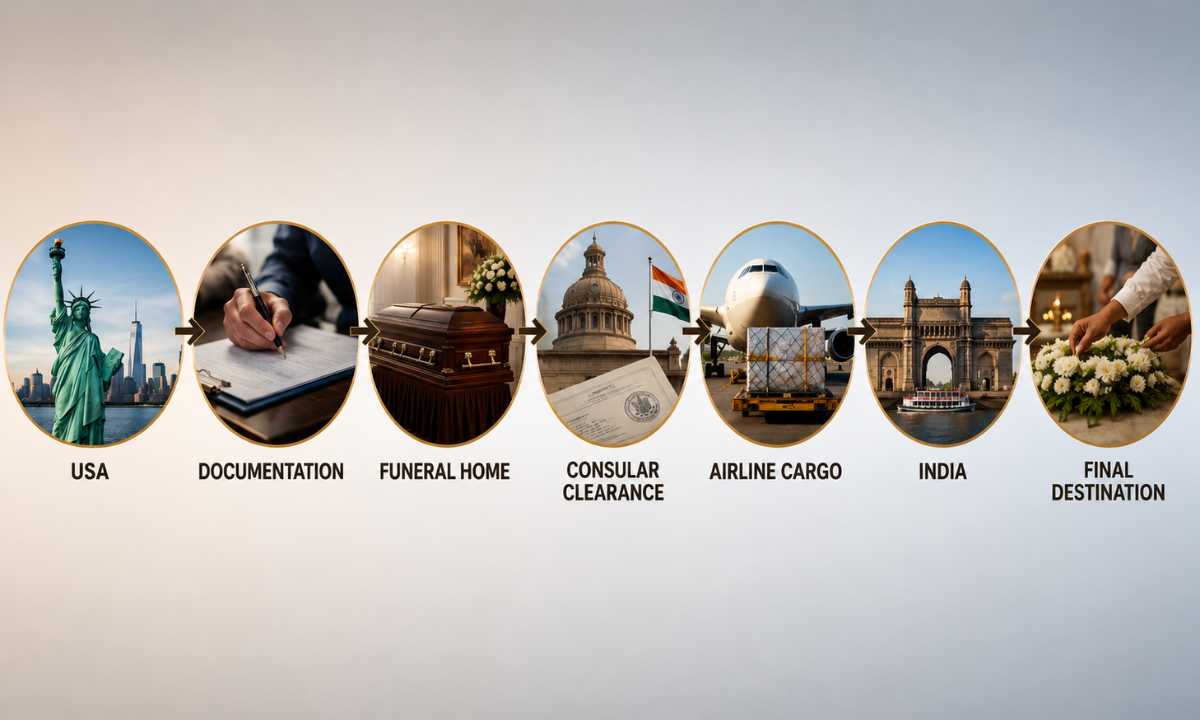
Repatriation means arranging the international transportation of a deceased person’s mortal remains from the country where the death occurred to the country where the family wants the final funeral or burial to take place. Repatriation Services from USA to India help coordinate the documentation, funeral-home arrangements, permits, airline requirements, and transportation involved in bringing the deceased back to India.
For an Indian family in New Jersey sending a loved one to Kerala, a family in Dallas arranging transportation to Hyderabad, or relatives in California arranging a funeral in Bangalore, the basic process is similar, but the local requirements and logistics can differ.
A repatriation case can involve coordinating:
- Hospital or medical facility
- Medical examiner or coroner, where applicable
- Licensed funeral home
- Local authorities
- Indian Embassy or Consulate
- Required certificates and permits
- Embalming and preparation
- Airline cargo arrangements
- Airport handling
- Customs-related procedures
- Transportation after arrival in India
- Receiving funeral home or family
The process is therefore better understood as a chain of handovers, rather than simply “shipping a body to India.”
Where Do Most USA-to-India Repatriation Requests Come From?
Indian communities are spread across the United States, but some metropolitan areas have particularly large Indian populations.
These include:
- New York and New Jersey
- Dallas-Fort Worth
- San Francisco Bay Area
- San Jose
- Chicago
- Washington, DC and Northern Virginia
- Houston
- Los Angeles
- Atlanta
- Philadelphia
- Seattle
Recent demographic research identifies New York, Dallas, San Francisco, Chicago, and San Jose among the largest metropolitan destinations for Indian immigrants in the United States.
This matters for repatriation because the location of the funeral home, airport, and consular jurisdiction can affect the practical process.
For example, a family in Fremont or San Jose may have a very different local transportation arrangement from a family in Newark or Edison, New Jersey.
Similarly, a family in Frisco, Plano, or Irving may use different local funeral and airport arrangements from a family in Houston.
Where in India Can the Deceased Be Repatriated?
The final destination depends on the family’s wishes and the arrangements available at the destination.
Common destinations may include major cities such as:
- Bangalore
- Hyderabad
- Chennai
- Mumbai
- Delhi
- Kochi
- Thiruvananthapuram
- Coimbatore
- Pune
- Ahmedabad
- Kolkata
- Mangalore
- Visakhapatnam
For example, a family in New Jersey may need transportation to Kochi, while relatives in Dallas may need the deceased transported to Hyderabad. A family in San Jose may choose Bangalore, while another family in Chicago may need arrangements in Chennai or Mumbai.
The international flight is only one part of the journey.
The receiving arrangements in the Indian city or town must also be organized before the remains leave the USA.
The First Thing to Do After a Death in the USA
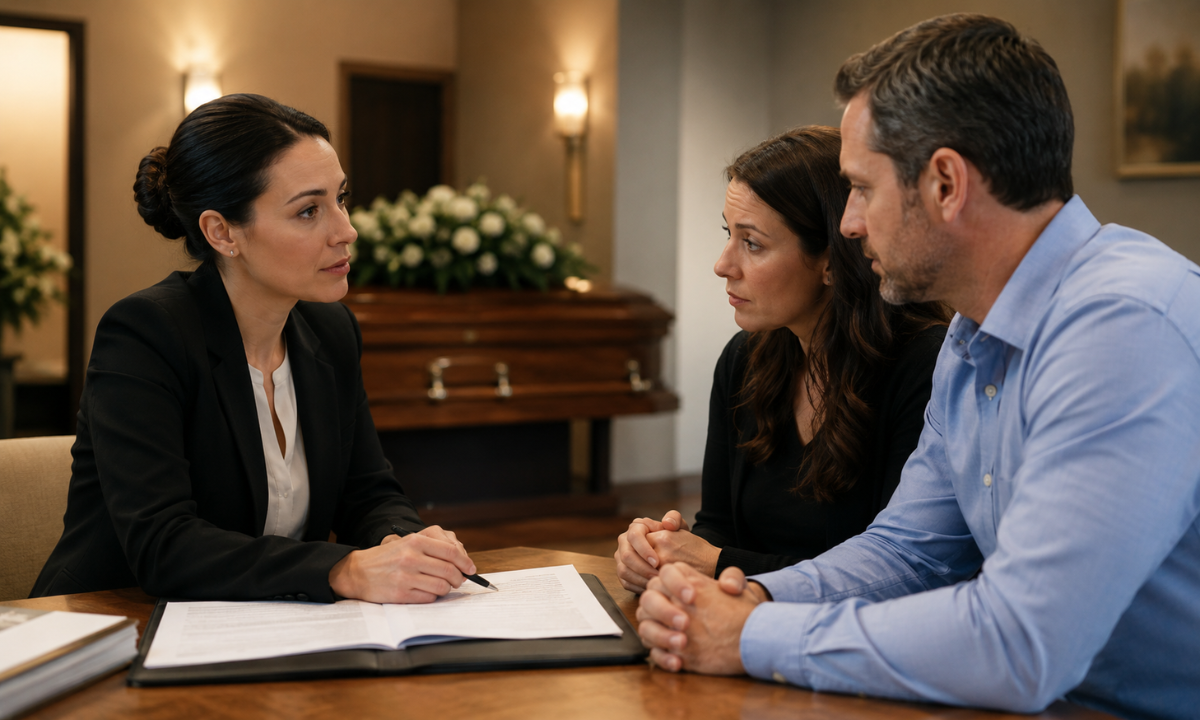
Families sometimes start by searching for airline information.
That is usually not the best first step.
The first priority should be to establish who currently has custody of the deceased and which funeral home or authorized professional will handle the arrangements.
If the person died in a hospital, nursing facility, hospice, or another setting, the institution may have its own release procedures. In some situations, a medical examiner or coroner may also be involved.
This is true whether the death occurred in New York City, Edison, New Jersey, Dallas, Houston, Chicago, San Jose, Fremont, Los Angeles, Atlanta, or another U.S. location.
The body cannot simply be collected and placed on an international flight.
A funeral home or qualified repatriation professional can help coordinate the release and subsequent preparation.
A useful practical rule
Do not book international transportation before confirming that the required local release and documentation steps can be completed.
An airline schedule may look convenient, but the documents and preparation have to be ready first.
Step 1: Confirm Where the Deceased Is Being Held
The first operational question is:
Where is the deceased right now?
It could be:
- A hospital
- A funeral home
- A medical examiner or coroner facility
- A nursing facility
- Another authorized location
The repatriation coordinator needs the exact location because transportation arrangements depend on where the remains are being released from.
The family should also identify the state where the death occurred because local procedures can differ.
For example, a case originating in New York may involve a different local process from one originating in Texas or California.
This is one reason a USA-to-India repatriation case cannot always be handled using a single nationwide checklist.
Step 2: Obtain the Death Certificate
The death certificate is one of the central documents in the repatriation process.
The family or authorized representative should obtain the appropriate death certificate from the relevant U.S. authority.
Pay particular attention to:
- Full name of the deceased
- Date of death
- Place of death
- Cause of death, where required
- Correct spelling of personal details
Some Indian consular processes specifically require the death certificate to contain the cause of death. For example, the Consulate General of India in Houston lists a death certificate clearly stating the cause of death among the documents required for carrying mortal remains.
Why checking the certificate early matters
A small documentation problem can become a much bigger problem later.
If names, dates, or other details need correction, the family may have to contact the issuing authority before the repatriation paperwork can be completed.
That is why document review should happen early rather than immediately before the flight.
Step 3: Identify the Correct Indian Consular Jurisdiction
This is an important point that generic repatriation articles often overlook.
You should not automatically contact whichever Indian Consulate appears first in a Google search.
The appropriate Indian Embassy or Consulate depends on where the death occurred and which consular jurisdiction covers that location.
For families living in major Indian-American communities, this can mean dealing with different Indian missions depending on whether the death occurred in:
- New York or New Jersey
- Texas
- California
- Illinois
- Georgia
- Washington, DC area
- Pennsylvania
- Other states
This is one reason a repatriation coordinator needs the exact city and state of death, not simply “USA.”
Step 4: Register the Death With the Indian Consulate When Required
For deceased Indian nationals, consular registration can be an important part of the process.
Current guidance from the Consulate General of India in San Francisco states that Indian nationals seeking transportation of mortal remains or ashes must first register the death with the Consulate through the eSEWA platform.
The Consulate’s eSEWA process also involves online submission and scrutiny of documents before the required original documents are handled according to the applicable procedure.
This creates an important practical distinction:
Online submission does not necessarily mean the entire repatriation process is completed online.
Families should be prepared for document verification and submission of originals where required.
Step 5: Prepare the Mortal Remains for International Transportation
Before the remains can be transported internationally, the deceased generally needs to be prepared according to the applicable health, funeral, and transportation requirements.
This commonly involves:
- Embalming
- Appropriate preparation
- Required certification
- Approved coffin or packaging arrangements
- Transit or burial permit documentation
For example, the San Francisco Consulate’s current guidance identifies the non-communicable disease certificate, embalming certificate, and transit permit for transportation of mortal remains.
Houston’s consular guidance similarly lists an embalming certificate, an infection-free certificate from the concerned local authority, and a burial/transit permit.
One important point
Do not assume that a document called an “embalming certificate” is automatically acceptable simply because a funeral home has issued one.
The relevant authority or consular jurisdiction may specify what information needs to appear on the document.
That is why documentation should be checked before the final airline booking.
Step 6: Check the Health-Related Documentation
Health documentation is another area where families can encounter delays.
The exact terminology can differ by jurisdiction, but consular checklists can require certification that the deceased is free from communicable or infectious disease.
This requirement exists because international transportation of human remains involves public-health and transportation considerations.
The safest approach is to obtain the certificate from the appropriate local authority and then have the documentation checked against the requirements of the Indian consular jurisdiction handling the case.
Step 7: Obtain the Transit or Burial Permit
The transit permit is another important document for international transportation.
The terminology and issuing authority can vary according to the U.S. state and local jurisdiction.
Do not assume that a funeral home’s internal paperwork automatically replaces the required permit.
The permit needs to be obtained from the appropriate authority and included with the transportation documentation.
This is one of the areas where professional coordination can save time because the funeral home, local authority, and repatriation coordinator need to work from the same case information.
Step 8: Complete the Indian Consular Documentation
The Indian consular process depends on the nationality and status of the deceased.
For example, the current San Francisco guidance separates requirements for:
- Indian passport holders
- U.S. passport holders with OCI
- U.S. passport holders
The document lists are not identical.
For an Indian passport holder, the Consulate’s checklist includes the deceased person’s passport and death certificate, along with documents of the relative or informant. Additional preparation and health documents are required for the transportation of mortal remains.
For a U.S. passport holder with an OCI, the documentation includes the passport and OCI documentation.
This creates an important lesson:
Don’t use a generic “India repatriation documents” checklist without first identifying the deceased person’s nationality and status.
Step 9: Coordinate With the Airline
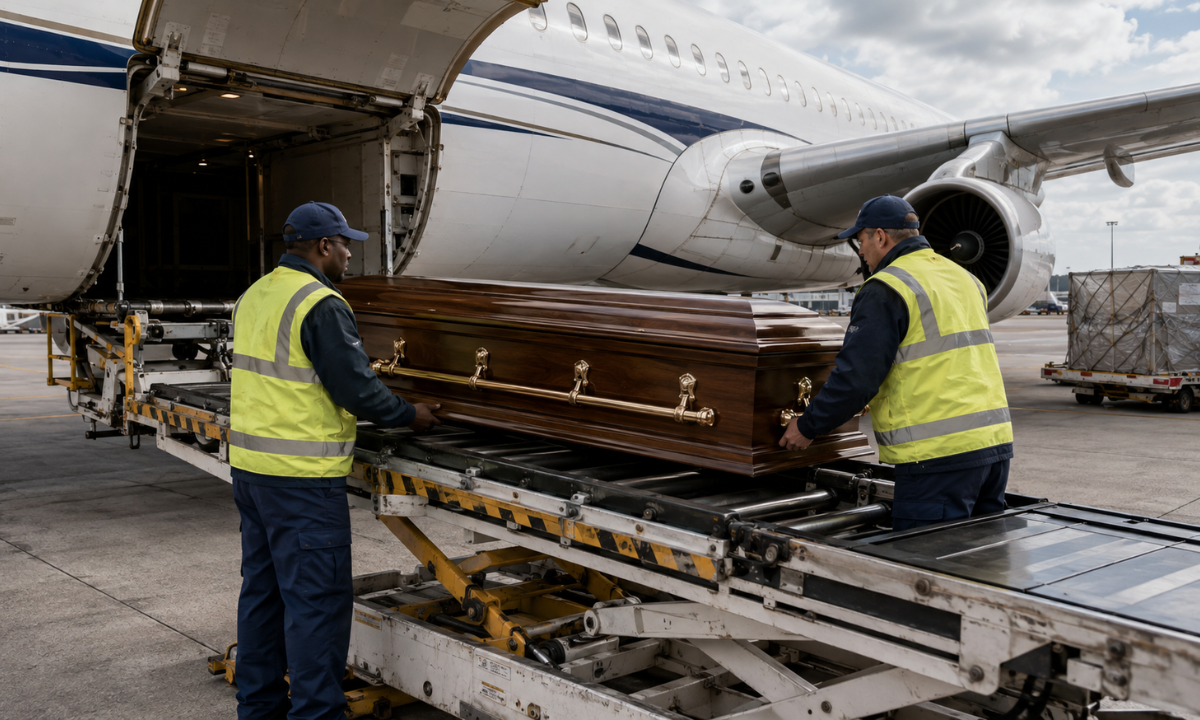
Once the documents and preparation are complete, airline transportation needs to be arranged.
Mortal remains are generally handled through specialized air-cargo procedures rather than ordinary passenger baggage.
The airline or cargo provider will have requirements concerning:
- Documentation
- Packaging
- Booking
- Cargo acceptance
- Airport handling
- Routing
- Timing
The available routing can affect the overall timeline.
A direct international flight may not always be available from the city where the death occurred.
For example, a case originating in Fremont or San Jose may need to be moved to an international gateway. Similarly, a case from New Jersey may require coordination around the New York metropolitan air-cargo network.
A family in Dallas, Houston, or Atlanta may also need domestic transportation before the international segment.
This is where route planning becomes more important than simply finding the cheapest flight.
A lower-cost route with multiple transfers may introduce additional handling and scheduling complexity.
Step 10: Arrange Airport Handling in the USA
Getting the remains to the airport is another separate logistical step.
The funeral home or repatriation company may need to coordinate:
Funeral home → local transportation → cargo terminal → airline acceptance → international flight
The timing matters.
The remains need to arrive at the correct cargo facility within the airline’s acceptance window with the required paperwork.
A family should not assume that arriving at an airport with the coffin is enough.
International human remains transportation is a coordinated cargo process.
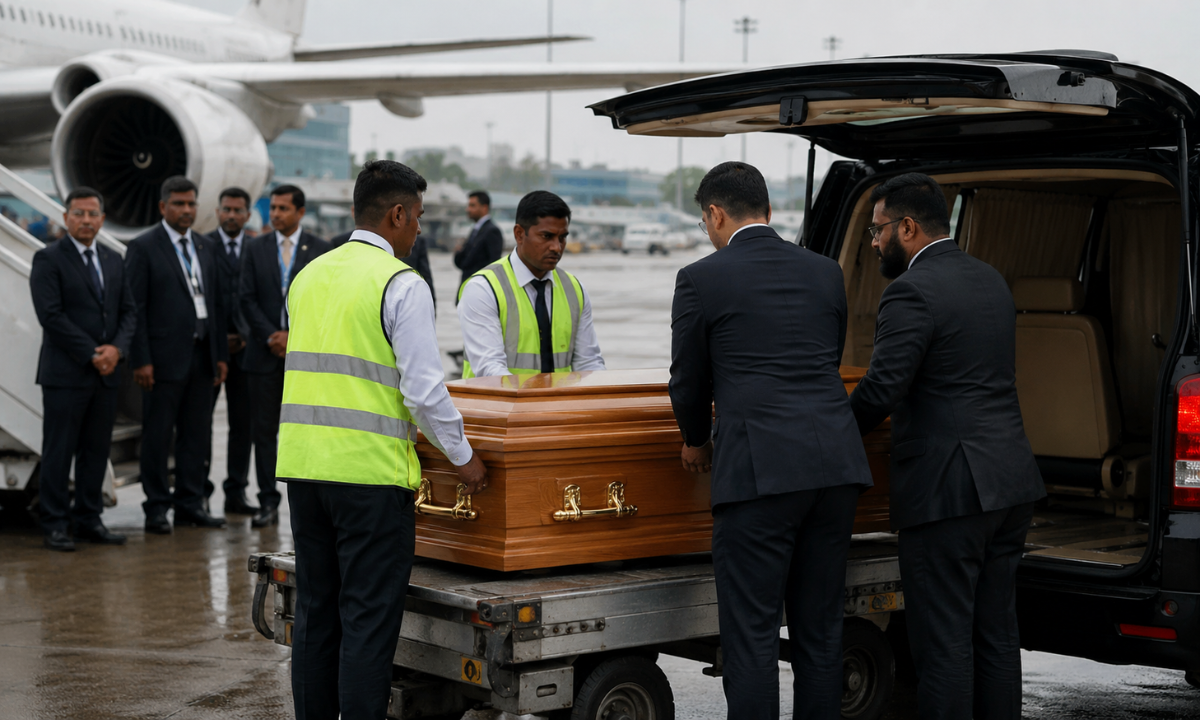
Step 11: Arrange the Receiving Side in India Before the Flight Leaves
This is one of the most important practical points that families can overlook.
The journey does not end when the aircraft lands in India.
Someone needs to be ready to receive the remains.
Depending on the destination, arrangements may include:
- Airport handling
- Customs-related procedures
- Local transportation
- Receiving funeral home
- Family coordination
- Final delivery
- Burial or cremation arrangements
For example, if the family wants the deceased taken to Bangalore, arrangements should be ready before arrival at the Indian airport.
The same applies if the final destination is Hyderabad, Chennai, Mumbai, Delhi, Kochi, Thiruvananthapuram, Mangalore, or another city.
This means a repatriation case should be planned from both ends at the same time.
The U.S. side prepares the deceased for departure.
The Indian side prepares for arrival.
A delay on either side can affect the entire journey.
What Documents Are Usually Required?
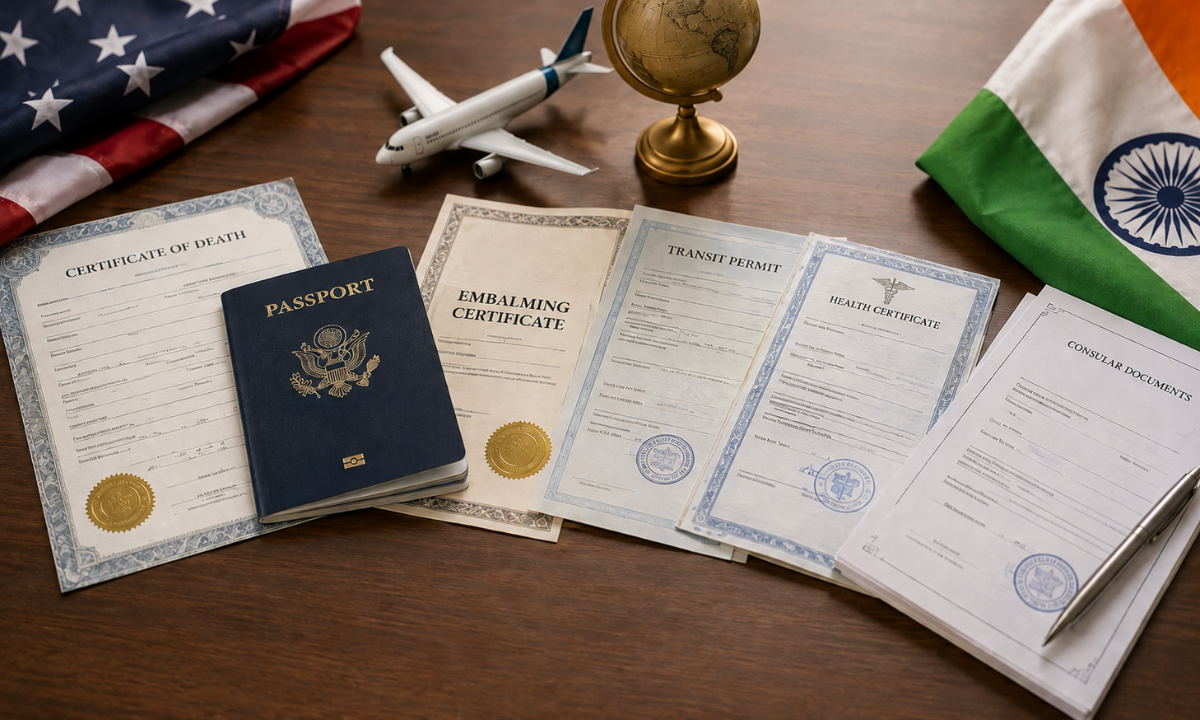
The exact requirements depend on the case and consular jurisdiction, but documents may include:
- Death certificate
- Passport of the deceased
- OCI documentation where applicable
- Embalming certificate
- Non-communicable or infection-related health certificate
- Transit or burial permit
- Consular documentation
- Documents of the relative or authorized representative
- Proof of address
- Airline/cargo documentation
For example, the current San Francisco checklist requires different documents depending on whether the deceased was an Indian passport holder, a U.S. passport holder with OCI, or a U.S. passport holder.
The Houston Consulate also identifies the death certificate, embalming certificate, infection-free certificate, and burial/transit permit for transportation of mortal remains.
Because requirements can change, families should verify the current requirements with the Indian mission responsible for their location.
How Long Does It Take to Bring a Body From the USA to India?
There is no single guaranteed timeline.
A straightforward case may move quickly when:
- The death certificate is available
- The deceased can be released immediately
- No investigation is pending
- Required certificates are obtained
- Consular documentation is complete
- Airline cargo space is available
- A receiving arrangement is ready in India
A case can take longer when there is:
- Medical examiner or coroner investigation
- Missing documents
- Corrections required on certificates
- Delays in embalming or preparation
- Consular document issues
- Limited airline cargo availability
- Weekend or holiday scheduling
- Complex routing
For this reason, it is better to ask a repatriation provider for a case-specific timeline rather than relying on a generic promise such as “48 hours” or “3 days.”
What If the Death Occurred in New York or New Jersey?
The New York metropolitan area has one of the largest Indian communities in the United States, so families in New York City, Jersey City, Edison, Iselin, Woodbridge, and surrounding New Jersey communities may frequently need assistance coordinating international arrangements.
The important thing is not the size of the Indian community alone.
The exact location where the death occurred determines which local authorities, funeral home, and consular procedures may apply.
A family living in Edison may have a loved one who died in another part of New Jersey or even New York.
Therefore, always provide the repatriation coordinator with the actual city and state of death, not simply the family’s home address.
What If the Death Occurred in Dallas or Houston?
Texas has one of the largest Indian populations in the United States, with major communities around Dallas-Fort Worth and Houston. Pew’s data also identifies Dallas and Houston among the major U.S. metropolitan areas with large Indian populations.
A case may originate from areas such as:
- Dallas
- Frisco
- Plano
- Irving
- Houston
- Sugar Land
- Katy
- The Woodlands
The same overall repatriation principles apply, but local release, funeral-home, and permit procedures need to be confirmed for the specific location.
What If the Death Occurred in California?
California has a particularly large Indian-American population, including major communities around San Jose, Fremont, Sunnyvale, Santa Clara, San Francisco, and the wider Bay Area. Current demographic data identifies California as having the largest state-level Indian population and the San Francisco and San Jose metropolitan areas as major Indian population centers.
A family in the Bay Area may therefore need arrangements from cities such as:
- San Jose
- Fremont
- Sunnyvale
- Santa Clara
- San Francisco
- Dublin
- San Ramon
The exact city matters because local transportation and funeral-home arrangements need to be coordinated before the international cargo movement.
What If the Death Was Accidental or Under Investigation?
This is an especially serious situation.
If the death is accidental, suspicious, or otherwise subject to investigation, the remains may not be immediately released.
The medical examiner, coroner, or law enforcement authorities may need to complete their procedures first.
This can happen whether the death occurred in New York, New Jersey, Texas, California, Illinois, Georgia, or another state.
A repatriation company cannot simply bypass the investigation.
The correct approach is to coordinate with the authorities and begin the parts of the repatriation process that can be completed while waiting for the release.
This is one reason early professional involvement can be useful.
How Much Does USA-to-India Repatriation Cost?
There is no reliable single price for every case.
The total cost can depend on:
- Funeral-home charges
- Transportation within the USA
- Embalming
- Coffin or approved packaging
- Certificates and permits
- Consular processing
- Airline cargo charges
- Airport handling
- Destination transportation in India
- Final funeral arrangements
- Route and destination
The cost of transporting a deceased person from New York to Delhi may not be the same as transporting remains from Dallas to Hyderabad or San Jose to Bangalore.
The cheapest quote is therefore not necessarily the cheapest complete service.
A better question is:
“What exactly is included in the quoted repatriation package?”
Ask whether the quotation includes both the U.S.-side and India-side arrangements.
What Beleiv Repatriation Can Do
Beleiv Repatriation provides coordination for international and domestic repatriation services and support with documentation, transportation, and arrangements in India.
For a family in New York, New Jersey, Dallas, Houston, Chicago, California, Washington, Atlanta or Philadelphia, the goal is to provide a single point of coordination rather than leaving relatives to contact several organizations separately.
That can involve coordinating information between:
Family → Funeral Home → Authorities → Indian Consulate → Airline/Cargo → India Receiving Team
For families sending their loved one to Bangalore, Hyderabad, Chennai, Mumbai, Delhi, Kerala, or another Indian destination, the receiving side also needs to be prepared before the flight leaves the USA.
The value of a repatriation coordinator is therefore not simply arranging a flight.
It is helping connect the different parts of the journey.
A Better Way to Think About the Repatriation Process

Think of the journey as five connected stages:
1. Release
The deceased is legally released by the hospital, medical examiner, coroner, or relevant authority.
2. Preparation
The funeral home prepares the remains and obtains the required certificates.
3. Authorization
The required consular, health, and transportation documents are completed.
4. Transportation
The remains are transferred to the appropriate airport and transported by air.
5. Reception
The remains are received in India and transported to the final destination.
If one stage is incomplete, the next stage can be delayed.
That is why repatriation is a coordination problem, not simply a transportation problem.
What Families Should Do Before Calling a Repatriation Service
Having a few basic details ready can make the first conversation much more productive.
Keep available:
- Full name of the deceased
- Date of death
- City and state where the death occurred
- Current location of the deceased
- Nationality
- Passport or OCI status
- Intended destination in India
- Funeral home’s contact details, if already appointed
- Death certificate, if available
- Whether the death is under investigation
- Preferred timeframe for the funeral in India
You do not need to have every document before contacting a professional.
In fact, calling early can help identify which documents need to be obtained first.
USA Cities We Can Help Coordinate From
Families may contact a repatriation service from anywhere in the United States, but Indian communities are particularly concentrated in areas including:
New York & New Jersey: New York City, Jersey City, Edison, Iselin, Woodbridge, and surrounding communities.
Texas: Dallas, Frisco, Plano, Irving, Houston, Sugar Land, Katy, and surrounding areas.
California: San Jose, Fremont, Sunnyvale, Santa Clara, San Francisco, Dublin, San Ramon, and surrounding Bay Area communities.
Illinois: Chicago and surrounding suburbs.
Washington, DC region: Washington, DC, Northern Virginia, and Maryland communities.
Georgia: Atlanta and surrounding suburbs.
Pennsylvania: Philadelphia and surrounding communities.
Washington State: Seattle, Bellevue, and surrounding communities.
These locations correspond broadly with areas where Indian communities are concentrated, rather than being an arbitrary list of cities.
Common India Destinations for Repatriation
The final destination is chosen by the family, but common Indian metropolitan and regional destinations can include:
- Bangalore
- Hyderabad
- Chennai
- Mumbai
- Delhi
- Kochi
- Thiruvananthapuram
- Mangalore
- Coimbatore
- Pune
- Ahmedabad
- Kolkata
- Visakhapatnam
The destination should be confirmed before the international transportation is finalized because the receiving arrangements need to be coordinated in advance.
Final Checklist
Before the remains leave the USA, confirm that:
- The deceased has been legally released
- The funeral home is authorized to handle the case
- Death certificate is available
- The required health certificate is available
- Embalming has been completed where required
- The embalming certificate is ready
- Transit or burial permit is ready
- Correct Indian consular jurisdiction has been identified
- The required consular process has been completed
- Passport or OCI documentation has been checked
- Airline cargo arrangements are confirmed
- Airport handling is arranged
- Receiving arrangements in India are confirmed
- Final transportation to the Indian destination is arranged
Final Thoughts
Bringing a loved one home from the USA to India is emotionally difficult, and the administrative process can make an already painful situation even harder.
For an Indian family in New York, New Jersey, Dallas, Houston, San Jose, Fremont, Chicago, Washington, Atlanta, or Philadelphia, knowing the first few steps can make the situation much easier to manage.
The process generally involves release, preparation, documentation, consular coordination, airline transportation, and reception in India.
The exact requirements can vary depending on the U.S. state, consular jurisdiction, nationality of the deceased, and circumstances of the death.
Current Indian consular guidance shows why checking the case-specific requirements matters: different categories of deceased persons can have different documentation requirements, and current consular services may involve online scrutiny followed by submission or verification of original documents.
The most important thing to remember is that the U.S. departure and Indian arrival should be planned together.
If the family wants the deceased brought home to Bangalore, Hyderabad, Chennai, Mumbai, Delhi, Kochi, Kerala or another Indian destination, the receiving arrangements should be started while the U.S. documentation and preparation are being completed.
At Beleiv Repatriation Services in India, the goal is to reduce the coordination burden on the family and help manage the journey with dignity, clear communication and practical support.
If your loved one has passed away in the USA and you need to bring the mortal remains to India, contact Beleiv as early as possible. The earlier the case is assessed, the easier it is to identify the documents, authorities, preparation and transportation steps that need to happen next.